
The ‘Hidden’ Cost of DIY Automation: Why CT Manufacturers Choose Professional Integrators
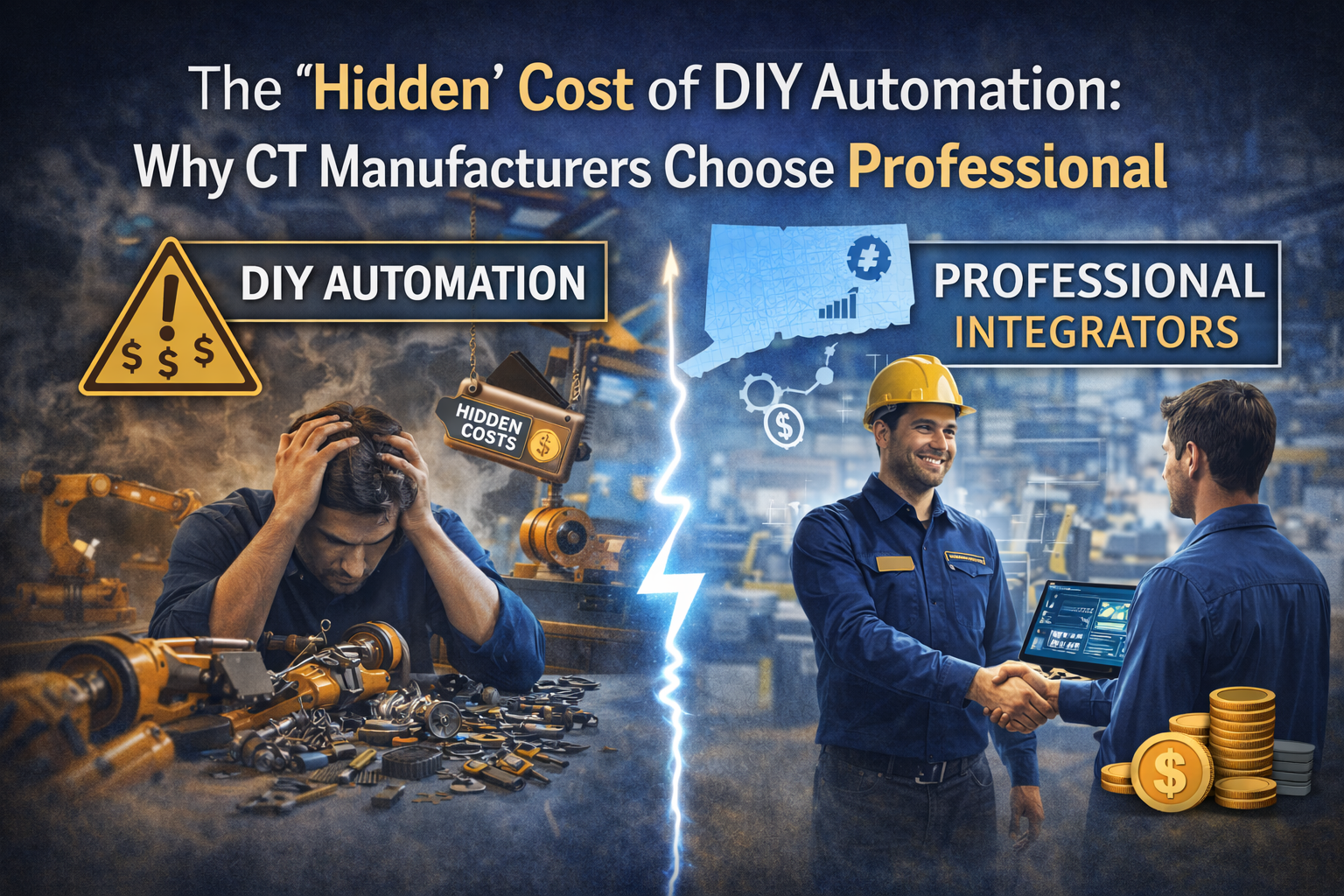
In the competitive landscape of Connecticut manufacturing, “lean” is more than a buzzword—it is a survival strategy. To cut costs, many plant managers in the Hartford and Naugatuck Valley regions consider “DIY Automation.” The logic is simple: buy the hardware, have an internal maintenance tech or a “tech-savvy” employee wire it up, and save on integrator fees.
However, in 2026, the hidden costs of DIY automation are becoming a major drain on mid-sized CT firms. What looks like a $20,000 savings on the front end often transforms into a $100,000 loss in downtime, safety risks, and lost throughput within the first year.
1. The “Fragile Integration” Trap
A professional integrator doesn’t just make a machine move; they build a resilient system.
- DIY Reality: An internal team might get a PLC to talk to a motor, but they often miss the edge cases. What happens when the network lags? What happens when a sensor gets dirty? DIY systems often lack the robust error-handling and “self-healing” logic that prevents a minor glitch from becoming a four-hour line stoppage.
- The Cost: At an average downtime cost of $5,600 per hour for CT manufacturers, just a few “unexplained” crashes per month completely erase any initial savings from skipping a professional integrator.
2. The Nightmare of Non-Standard Code
When a DIY project is built, it’s usually built in the specific style of the person doing the work.
- The “Bus Factor”: If the one person who programmed your custom SCADA or PLC logic leaves for a competitor in Stamford or moves out of state, your system is now a “Black Box.” No one else knows how to fix it or update it.
- Professional Standards: Professional integrators like Pronto follow industry standards (like ISA-95 and S88). Our code is documented, modular, and designed so that any qualified engineer can walk in and understand the architecture. This “future-proofs” your investment.
3. Compliance and Safety Risks
Connecticut has some of the strictest workplace safety and environmental regulations in the country.
- Safety Shortfalls: DIY projects often overlook complex safety interlocks or fail to meet the latest ISO 13849-1 standards for robotic cells. A single “near-miss” or an OSHA inspection can result in fines that far exceed the cost of professional integration.
- Cybersecurity: In 2026, every connected PLC is a potential entry point for ransomware. DIY setups rarely include the VLAN segmentation or VPN-only access required to keep your plant floor secure.
Why Professional Integration is an ROI Multiplier
When you hire a professional integrator in Connecticut, you aren’t just paying for labor; you are buying operational insurance.
| DIY Automation | Professional Integration (Pronto) |
| Reactive: Fixes problems as they appear. | Proactive: Implements predictive maintenance alerts. |
| Siloed: Data stays on the machine. | Integrated: Syncs with Business Central/Insight Works. |
| High Maintenance: Requires constant “tinkering.” | High Uptime: Built for 24/7 industrial reliability. |
| Single Point of Failure: Relies on one internal “guru.” | Scalable: Supported by a team of local experts. |
The Local Pronto Advantage
We’ve seen the “salvage jobs” where a DIY project went wrong. Our team specializes in stepping in to stabilize these systems, bringing them up to code, and ensuring they actually deliver the ROI promised in the original budget.
FAQ: DIY vs. Professional Automation
Why shouldn’t my in-house maintenance team handle the SCADA rollout?
Your maintenance team’s primary job is to keep current production running. Asking them to design and code a complex SCADA system often leads to “half-finished” projects and distracted staff, resulting in more downtime for existing machines.
Is professional integration too expensive for small CT shops?
Actually, it’s often more expensive not to use a professional. We offer “Phased Implementations” that allow small manufacturers to automate one cell at a time, ensuring each step pays for itself before moving to the next.
How does a professional integrator help with cybersecurity?
We implement “Defense in Depth.” This includes isolating your control network from the office Wi-Fi, setting up secure remote access, and ensuring your PLCs aren’t exposed to the open internet—steps often missed in DIY setups.
Can a professional integrator help me get CT state grants?
Yes. To qualify for the Manufacturing Innovation Fund (MIF), the state often requires a formal proposal from a certified integrator. A DIY project typically lacks the technical documentation required to win these grants.
What happens if a professional system breaks?
Unlike a DIY system where you are on your own, Pronto provides SLA-backed support. Because we use standardized code, our team can troubleshoot your system remotely or on-site in Connecticut within hours.