
SCADA vs MES vs ERP: What’s the Difference for Connecticut Manufacturers?
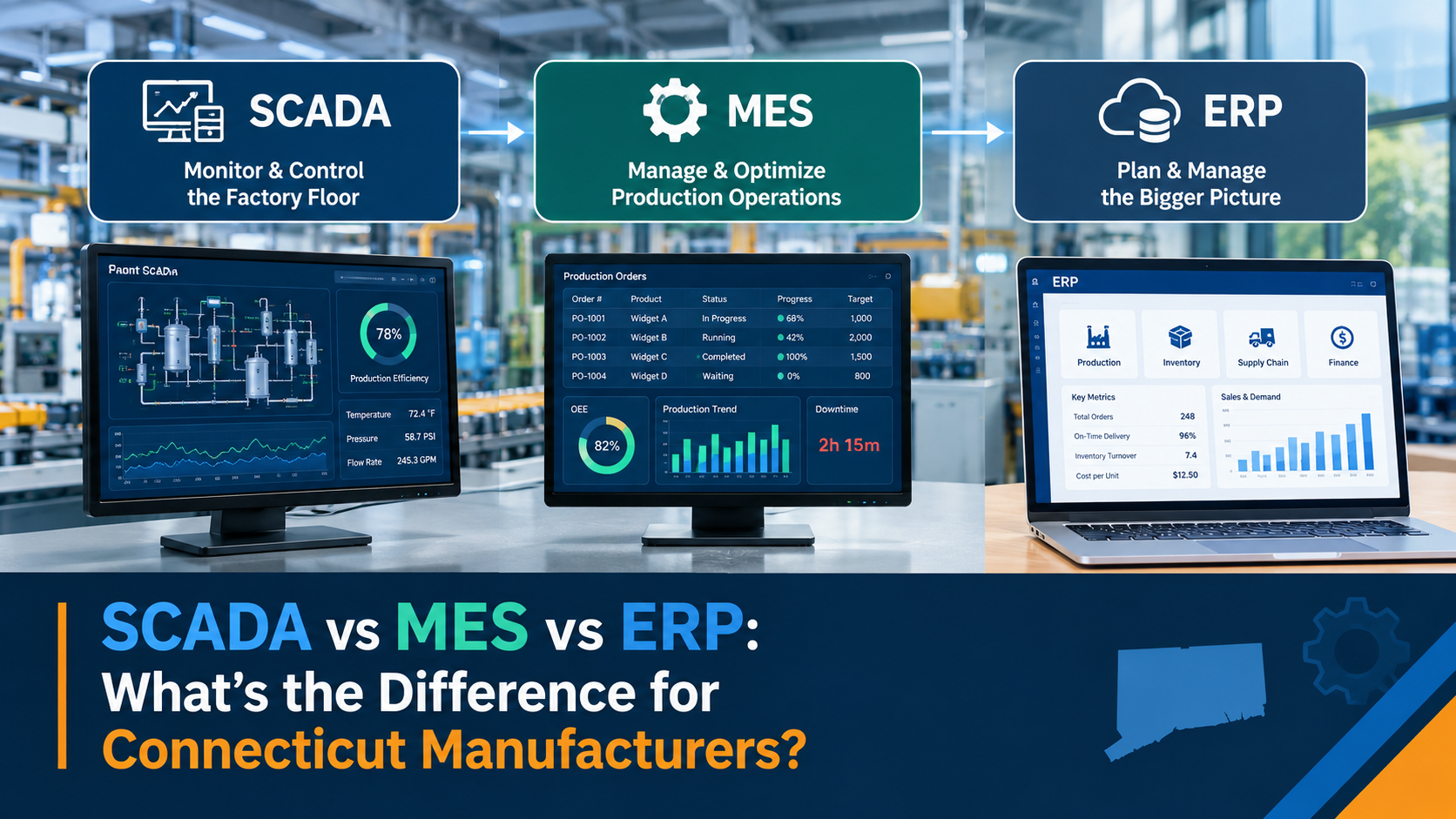
Manufacturing plants use different software systems to monitor equipment, manage production, and run business operations. Three of the most common are SCADA, MES, and ERP.
While these systems can work together, they serve different purposes.
SCADA monitors and controls manufacturing equipment and processes. MES manages and tracks production activities. ERP manages broader business operations such as purchasing, inventory, finance, sales, and order management.
For Connecticut manufacturers looking to modernize their plants, understanding the difference between SCADA, MES, and ERP is an important first step toward building a connected manufacturing environment.
SCADA vs MES vs ERP: Quick Comparison
| System | Primary Purpose | Main Users | Typical Data |
| SCADA | Monitor and control equipment and processes | Operators, engineers, maintenance teams | Machine status, alarms, temperatures, pressures, process data |
| MES | Manage and improve production | Production, quality, operations | Production orders, OEE, quality, downtime, traceability |
| ERP | Manage business operations | Management, finance, purchasing, sales | Orders, inventory, purchasing, accounting, business data |
The three systems are not necessarily alternatives. In a modern manufacturing plant, they can work together to connect the plant floor with production management and business operations.
What Is SCADA?
SCADA stands for Supervisory Control and Data Acquisition.
SCADA software allows manufacturers to monitor equipment and processes in real time. It collects information from PLCs, machines, sensors, and other industrial devices and presents that information through operator interfaces and dashboards.
A SCADA system can help a plant monitor:
- Machine operating status
- Production processes
- Temperatures and pressures
- Alarms and events
- Equipment performance
- Production counts
- Energy consumption
- Historical process data
- Equipment trends
SCADA can also provide operators with the information they need to respond to problems quickly.
For example, if a machine stops unexpectedly, an operator can use the SCADA interface to see the alarm, identify the affected equipment, review process information, and take the appropriate action.
What Is Ignition SCADA?
Ignition is an industrial application platform used for SCADA, visualization, data collection, reporting, and manufacturing applications.
For Connecticut manufacturers, an Ignition SCADA system can provide a centralized way to connect machines, PLCs, databases, and production information.
A properly designed SCADA system can also provide the foundation for integrating plant-floor data with MES and other manufacturing applications.
What Is MES?
MES stands for Manufacturing Execution System.
While SCADA focuses primarily on monitoring and controlling processes, MES focuses on managing what is happening in production.
An MES can help manufacturers track:
- Production orders
- Work-in-progress
- Production quantities
- Product traceability
- Quality information
- Production downtime
- OEE
- Material usage
- Production schedules
- Operator activities
- Manufacturing performance
For example, a manufacturer may use SCADA to determine whether a machine is running, while MES can use that information to determine how efficiently the production order is being completed.
How MES Can Improve Manufacturing Productivity
MES software can help production teams move beyond simply collecting machine data.
Instead of asking:
“Is the machine running?”
a production manager can ask:
“Are we producing the required quantity, at the expected rate, with the expected quality?”
This distinction is important for manufacturers trying to improve productivity.
For Connecticut manufacturers, an MES can provide better visibility into production performance across individual machines, production lines, departments, or facilities.
What Is ERP?
ERP stands for Enterprise Resource Planning.
ERP systems manage the broader business side of a manufacturing organization.
Common ERP functions include:
- Accounting
- Purchasing
- Inventory
- Sales
- Customer orders
- Supply chain management
- Human resources
- Financial reporting
An ERP system may know that a customer has ordered 10,000 units of a product.
The MES can manage the production of those units.
SCADA can monitor the machines and processes producing them.
This creates a connected flow of information from the business system to production and ultimately to the equipment operating on the plant floor.
How SCADA, MES, and ERP Work Together
The easiest way to understand the relationship is to look at the flow of information.
ERP → MES → SCADA → Machines
And information can flow back in the opposite direction:
Machines → SCADA → MES → ERP
For example, imagine a Connecticut manufacturer receives an order for 5,000 components.
Step 1: ERP
The ERP system records the customer order and determines the business requirements.
Step 2: MES
The MES manages the production order, scheduling, materials, quality requirements, and production tracking.
Step 3: SCADA
The SCADA system monitors the machines and processes producing the components.
Step 4: PLCs and Equipment
PLCs control the actual industrial equipment and manufacturing processes.
Step 5: Data Returns to Management
Production information can move back through SCADA and MES, providing management with information about production quantities, downtime, quality, and performance.
This creates a more connected manufacturing environment.
SCADA vs MES: What Is the Main Difference?
The simplest distinction is:
SCADA answers: “What is happening with my equipment and process right now?”
MES answers: “What is happening with my production?”
SCADA is heavily focused on real-time monitoring, control, alarms, visualization, and industrial data.
MES focuses more on production management, traceability, quality, OEE, scheduling, and manufacturing performance.
However, the two systems work particularly well together because MES applications often need reliable information from machines and processes.
MES vs ERP: What Is the Difference?
MES sits between the plant floor and the business system.
ERP manages the business.
MES manages manufacturing execution.
For example:
ERP: We need to manufacture 5,000 parts.
MES: Here is the production order, schedule, materials, quality requirements, and production progress.
SCADA: Here is what the machines and processes are doing right now.
This separation allows each system to focus on the information and functions it is designed to manage.
Does a Manufacturer Need All Three?
Not necessarily.
The right architecture depends on the size of the operation, existing equipment, production processes, business requirements, and digital maturity.
A smaller manufacturing operation may start with:
PLC + HMI + SCADA
As production requirements become more complex, the company may add:
SCADA + MES
The business may already have an ERP system, creating:
ERP + MES + SCADA
The goal should not be to install technology simply because it is available.
The goal should be to determine what information your plant needs, where that information comes from, and how it can help employees make better decisions.
Why SCADA and MES Integration Matters
SCADA and MES can provide significantly more value when they are connected.
For example, SCADA may collect:
- Machine runtime
- Machine downtime
- Production counts
- Process values
- Alarm information
MES can use this information for:
- OEE calculations
- Downtime analysis
- Production reporting
- Quality tracking
- Production performance
- Traceability
This reduces the need for operators and managers to manually collect information from different systems.
It also creates a more consistent source of production data.
What About Legacy Manufacturing Equipment?
One of the biggest challenges for Connecticut manufacturers is that many plants operate a mixture of newer and older equipment.
A facility may have:
- New automated production lines
- Older PLCs
- Standalone machines
- Existing HMIs
- Separate databases
- Older control systems
Replacing every machine is not always practical.
A better approach can be to connect existing equipment and modernize the software and data architecture around it.
Modern SCADA platforms such as Ignition can provide a way to bring information from different industrial systems into a centralized environment.
This can allow manufacturers to improve visibility without immediately replacing every piece of production equipment.
How Connecticut Manufacturers Can Approach Digital Modernization
For a Connecticut manufacturing company considering SCADA, MES, or ERP integration, a practical approach is to start with the biggest operational problem.
For example:
Problem: Frequent machine downtime
Potential solution: SCADA monitoring and downtime tracking
Problem: Poor visibility into production performance
Potential solution: SCADA + MES
Problem: Difficulty tracking work-in-progress
Potential solution: MES
Problem: Production and business systems are disconnected
Potential solution: MES and ERP integration
Problem: Multiple legacy machines cannot easily share data
Potential solution: Industrial automation and SCADA integration
This approach helps manufacturers build a technology roadmap based on business needs rather than simply purchasing software.
How Pronto System Solutions Can Help
For manufacturers evaluating SCADA, MES, PLC, and industrial automation solutions in Connecticut, Pronto System Solutions provides factory automation implementation and integration services focused on connecting manufacturing technology with operational needs.
Its capabilities include Ignition SCADA, MES, PLC programming, HMI development, electrical design, automation integration, and manufacturing data solutions.
Pronto can help manufacturers evaluate existing equipment, connect plant-floor systems, develop SCADA applications, implement MES functionality, and create a more connected manufacturing environment.
For a Connecticut manufacturer, this can provide a practical path from disconnected equipment and manual processes toward better production visibility and automation.
Frequently Asked Questions
Is SCADA the same as MES?
No. SCADA primarily monitors and controls industrial processes and collects equipment data. MES focuses on managing and tracking manufacturing operations, including production, quality, traceability, OEE, and work-in-progress.
Is MES the same as ERP?
No. ERP manages broader business functions such as finance, purchasing, inventory, sales, and orders. MES focuses specifically on manufacturing execution and production operations.
Can SCADA, MES, and ERP work together?
Yes. SCADA, MES, and ERP can be integrated so that information can move between the plant floor, production management, and business systems.
What is Ignition SCADA?
Ignition is an industrial application platform that can be used to build SCADA systems, HMIs, dashboards, data collection applications, reports, and other manufacturing applications.
Do small manufacturers need an MES?
Not necessarily. The need for MES depends on production complexity, traceability requirements, quality requirements, production volume, and the manufacturer’s need for real-time production visibility.
What does an Ignition integrator do?
An Ignition integrator helps manufacturers design, develop, configure, and integrate Ignition applications with PLCs, machines, databases, SCADA systems, MES applications, and other manufacturing technologies.
How can Connecticut manufacturers modernize legacy equipment?
Manufacturers can often modernize legacy equipment by connecting existing PLCs and machines to modern SCADA, collecting production data, improving visualization, and gradually integrating MES and other systems rather than replacing every machine at once.
Final Takeaway
SCADA, MES, and ERP are designed to solve different manufacturing problems.
SCADA connects manufacturers to their equipment and processes. MES connects manufacturers to their production operations. ERP connects the business to its broader operations.
When these systems are properly integrated, manufacturers can create a more connected flow of information from the machine on the plant floor to the production team and business leadership.
For Connecticut manufacturers looking to improve automation, production visibility, OEE, data collection, or plant-floor integration, starting with a clear understanding of the role of SCADA, MES, and ERP can help build a practical and scalable modernization strategy.
Pronto System Solutions can help Connecticut manufacturers evaluate and implement the SCADA, MES, PLC, and automation technologies needed to move toward a more connected manufacturing operation.