
Predictive Maintenance for Food & Beverage Plants: How SCADA Reduces Unplanned Downtime
Executive Summary
Unexpected equipment failures can bring an entire production line to a halt, leading to product waste, missed delivery schedules, increased maintenance costs, and compliance risks. In the food and beverage industry, where uptime, product quality, and regulatory standards are critical, reactive maintenance is no longer sufficient.
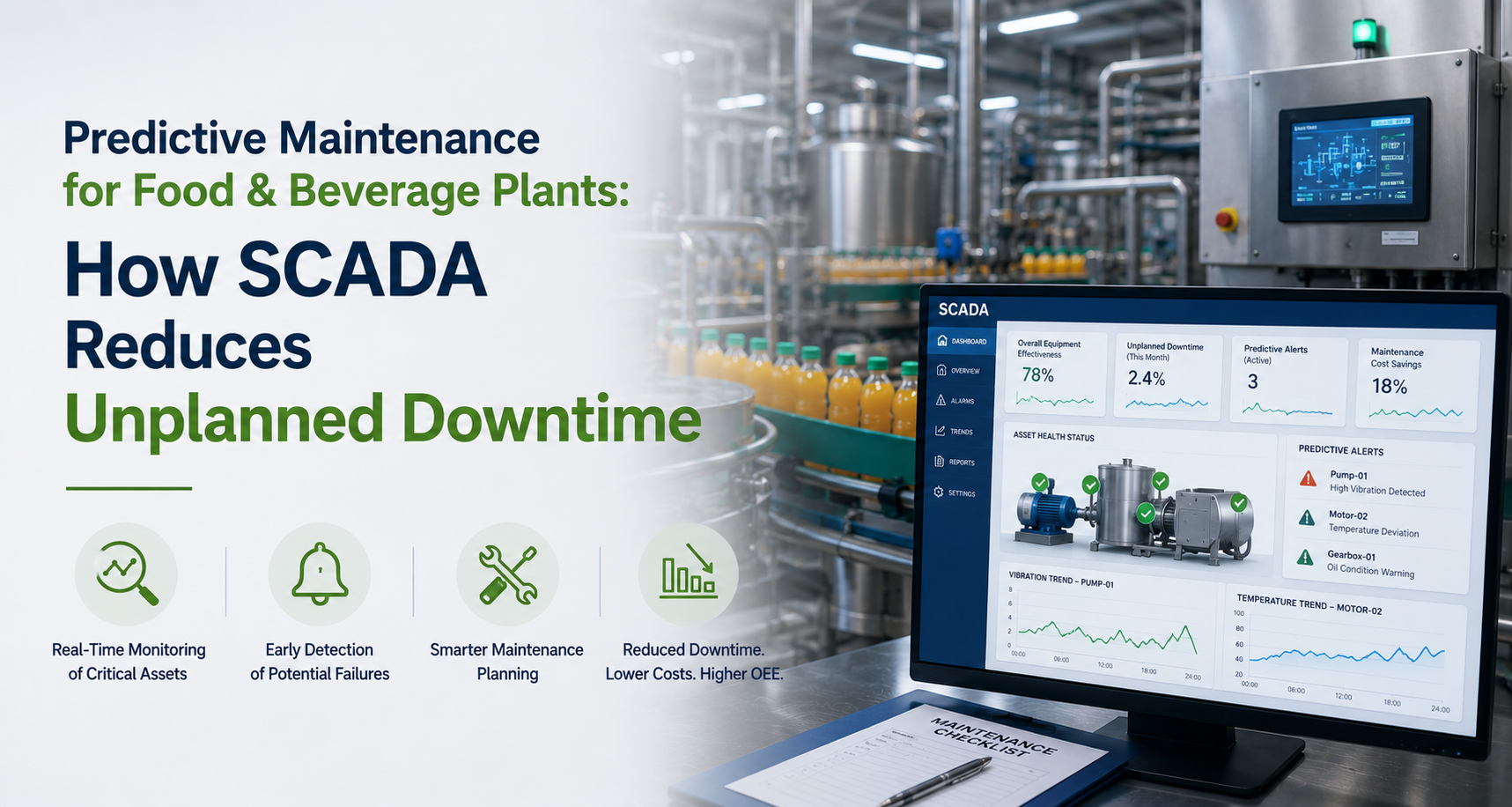
Predictive maintenance powered by modern SCADA software enables manufacturers to monitor equipment health in real time, identify early warning signs of failure, and schedule maintenance before breakdowns occur. When integrated with PLCs, sensors, and Manufacturing Execution Systems (MES), SCADA provides the operational intelligence needed to improve asset reliability and maximize Overall Equipment Effectiveness (OEE).
For manufacturers in Connecticut, implementing SCADA software solutions with the support of an experienced systems integrator can significantly reduce unplanned downtime while supporting long-term operational excellence.
Why Predictive Maintenance Matters in Food & Beverage Manufacturing
Food and beverage facilities operate in highly regulated environments where every minute of downtime impacts productivity, product quality, and profitability. Critical assets such as mixers, conveyors, filling machines, refrigeration systems, packaging equipment, and CIP (Clean-in-Place) systems must perform consistently to maintain production schedules.
Traditional maintenance strategies often fall into two categories:
- Reactive Maintenance: Equipment is repaired only after it fails, resulting in costly downtime and emergency repairs.
- Preventive Maintenance: Maintenance is performed on a fixed schedule, regardless of the equipment’s actual condition, which can lead to unnecessary servicing.
Predictive maintenance takes a smarter approach by using live operational data to determine when maintenance is truly needed, reducing both unexpected failures and unnecessary maintenance activities.
How SCADA Supports Predictive Maintenance
A modern SCADA process monitoring system collects and analyzes real-time data from production equipment, allowing maintenance teams to detect abnormal operating conditions before they become critical failures.
Typical data points monitored include:
- Motor temperature
- Vibration levels
- Pump pressure
- Conveyor speed
- Compressor performance
- Refrigeration temperatures
- Energy consumption
- Production cycle times
By continuously monitoring these parameters, SCADA systems can trigger alerts when equipment operates outside predefined thresholds, enabling maintenance teams to take corrective action before production is affected.
This proactive approach not only extends equipment life but also improves plant reliability and operational efficiency.
Key Benefits of SCADA-Based Predictive Maintenance
1. Reduce Unplanned Downtime
Unexpected equipment failures often disrupt production schedules and increase operational costs. A well-designed SCADA software solution provides continuous monitoring and automated alerts, allowing maintenance teams to address potential issues before they result in costly shutdowns.
For food manufacturers operating multiple production lines, even a small reduction in downtime can lead to significant annual savings.
2. Improve Equipment Reliability
Monitoring machine health in real time enables maintenance teams to identify trends that indicate wear or performance degradation.
Examples include:
- Rising motor temperatures
- Increased vibration in rotating equipment
- Abnormal pressure fluctuations
- Longer production cycle times
Addressing these issues early helps prevent catastrophic failures and extends the lifespan of critical assets.
3. Enhance Food Safety and Compliance
Maintaining precise process conditions is essential for food safety. SCADA systems continuously monitor variables such as temperature, pressure, and production parameters to ensure compliance with food safety standards.
Automated data logging also simplifies audits by providing historical records for regulatory reporting and quality assurance.
4. Increase Production Efficiency
Modern automation and SCADA integration allows manufacturers to combine machine monitoring, production reporting, and maintenance management into a single platform.
This integrated approach helps operations teams:
- Improve Overall Equipment Effectiveness (OEE)
- Reduce production bottlenecks
- Optimize maintenance schedules
- Minimize product waste
- Improve production planning
The result is a more efficient manufacturing operation with greater visibility across the production floor.
5. Enable Data-Driven Decision Making
One of the greatest SCADA capabilities is transforming raw machine data into actionable insights. Interactive dashboards provide plant managers with real-time visibility into equipment performance, maintenance trends, and production KPIs.
Instead of relying on assumptions, teams can prioritize maintenance based on actual equipment condition, leading to better resource allocation and lower operating costs.
Why Ignition SCADA Is a Strong Choice
Many manufacturers are adopting Ignition SCADA because of its scalability, open architecture, and ability to integrate with PLCs, MES platforms, ERP systems, and Industrial IoT devices.
An experienced Ignition SCADA integrator can configure dashboards, alarms, historical data logging, and predictive maintenance workflows tailored to your facility’s needs. As production grows, additional equipment and production lines can be integrated without requiring major system redesigns.
For manufacturers seeking a future-ready Ignition control system, this flexibility makes Ignition a valuable long-term investment.
A Practical Example
Consider a beverage manufacturer whose bottling line relies on multiple pumps and conveyor motors. In a reactive maintenance environment, a bearing failure could stop production for several hours, resulting in lost output and delayed shipments.
With a SCADA process monitoring system, sensors continuously monitor vibration and motor temperature. As abnormal readings begin to trend upward, the system automatically alerts the maintenance team. Repairs are scheduled during planned downtime, preventing an unexpected breakdown and minimizing disruption.
This proactive strategy improves asset reliability while reducing emergency maintenance costs.
Why Connecticut Manufacturers Are Investing in Predictive Maintenance
Manufacturers across Connecticut are embracing digital transformation to remain competitive in industries such as food processing, beverage production, pharmaceuticals, and advanced manufacturing.
By implementing SCADA software solutions and working with experienced automation specialists, local businesses can modernize legacy operations, improve production visibility, and build a foundation for Industry 4.0 initiatives.
Choosing a partner with expertise in industrial automation ensures that predictive maintenance strategies are aligned with existing production processes and future growth plans.
Conclusion
Predictive maintenance is no longer a luxury it’s a competitive advantage for food and beverage manufacturers. By leveraging modern SCADA software, manufacturers can monitor equipment health in real time, reduce unplanned downtime, improve product quality, and optimize maintenance resources.
Whether you’re upgrading an existing automation system or planning a new digital transformation initiative, investing in predictive maintenance delivers measurable improvements in efficiency, reliability, and operational performance.
For manufacturers in Connecticut, partnering with an experienced industrial automation provider can help you implement scalable SCADA and MES solutions that keep production running smoothly today while preparing your facility for tomorrow’s manufacturing challenges.
Frequently Asked Questions
What is predictive maintenance in food and beverage manufacturing?
Predictive maintenance uses real-time equipment data, sensors, and analytics to identify potential failures before they occur, allowing maintenance teams to schedule repairs proactively.
How does SCADA help reduce downtime?
SCADA continuously monitors machine performance, detects abnormal operating conditions, and generates alerts before equipment failures impact production.
Can SCADA integrate with existing PLC systems?
Yes. Modern SCADA platforms, including Ignition, support integration with most major PLC brands, enabling manufacturers to modernize operations without replacing existing equipment.
Is predictive maintenance suitable for small and mid-sized manufacturers?
Absolutely. Scalable SCADA platforms allow manufacturers of all sizes to implement predictive maintenance based on their operational requirements and budget.
Why choose an experienced SCADA systems integrator?
A qualified systems integrator can design, implement, and optimize SCADA solutions that integrate seamlessly with your production environment, helping you maximize system performance and return on investment.