
Navigating Connecticut’s 2026 Peak Demand Charges with Smart SCADA Energy Monitoring
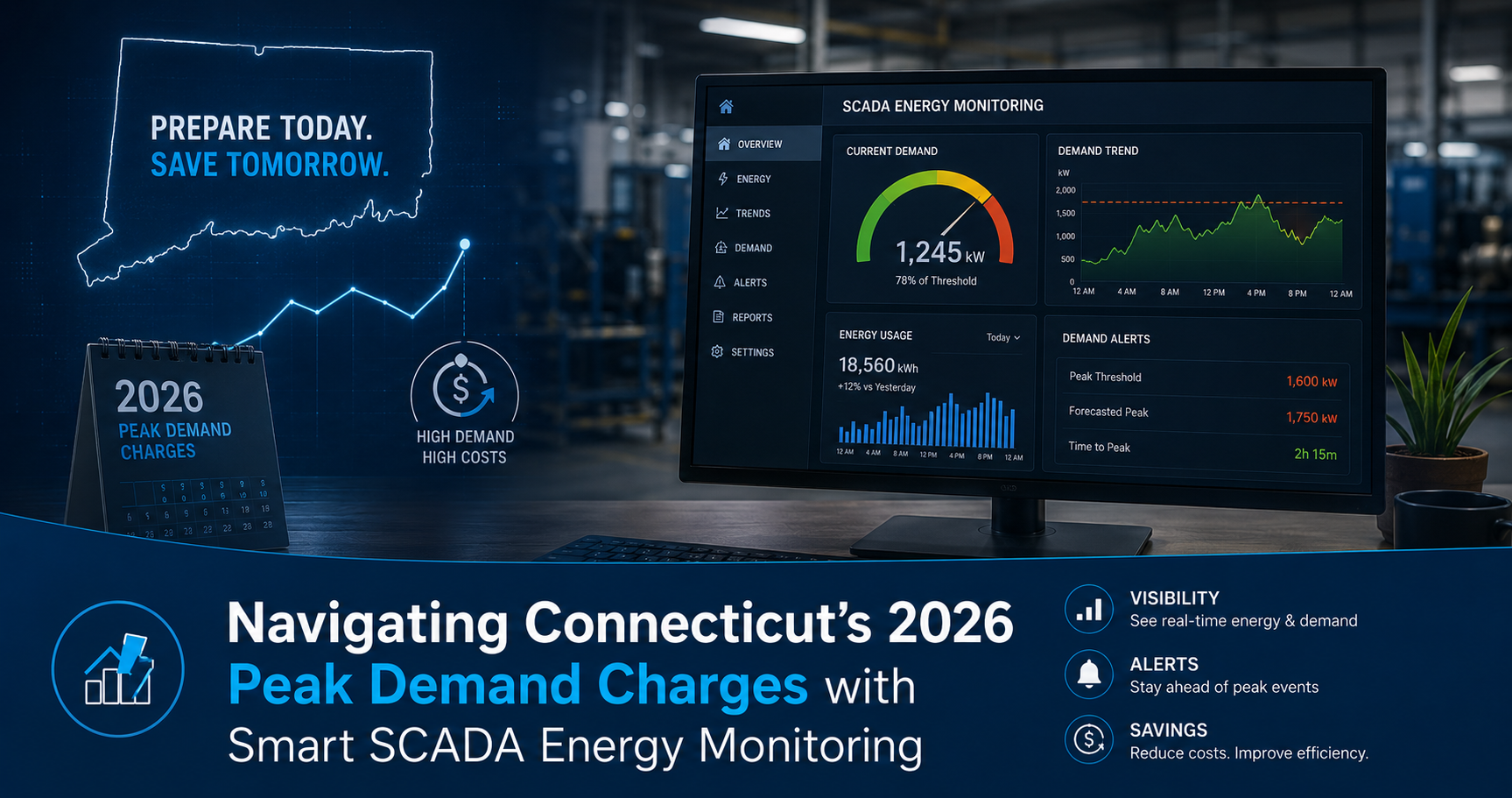
What Connecticut Manufacturers Need to Know About 2026 Peak Demand Charges
Energy costs have always been a significant line item for Connecticut manufacturers. But heading into 2026, peak demand charges are drawing more attention than ever across the industrial sector. Eversource and United Illuminating, the two primary electric utilities serving Connecticut, structure commercial and industrial electricity bills in a way that can make a single hour of high energy consumption responsible for a substantial portion of an entire month’s electric bill.
For manufacturers in Hartford, Waterbury, New Haven, Bridgeport, Torrington, and across the state, understanding how peak demand charges work and taking active steps to manage them is no longer optional. It is a direct competitive advantage. Companies that manage their demand peaks effectively pay significantly less for electricity than companies running identical equipment but without any demand management strategy in place.
Smart SCADA energy monitoring is one of the most effective tools available to Connecticut manufacturers for controlling peak demand costs. Pronto System Solutions helps manufacturers across Connecticut design and implement SCADA-based energy monitoring systems that provide real-time visibility into energy consumption, alert teams before demand peaks occur, and generate the data needed to make smarter operational decisions every single day.
Understanding Peak Demand Charges in Connecticut
Before explaining how SCADA monitoring addresses the problem, it is worth being clear about what peak demand charges actually are and why they hit manufacturers so hard.
Your monthly electric bill from Eversource or United Illuminating is not based purely on how many kilowatt-hours your facility consumes. A significant portion of the bill is based on your peak demand, which is the highest level of power your facility draws at any single point during the billing period, typically measured in 15-minute intervals. That peak number, expressed in kilowatts, is then multiplied by a demand rate that can range from $10 to $25 or more per kilowatt depending on your rate class and time of year.
The math is unforgiving. If your facility reaches a peak demand of 500 kilowatts during a single 15-minute window because three large motors started simultaneously at the beginning of a shift, you may be billed for that 500 kW peak for the entire month, even if your demand was significantly lower for the remaining 99 percent of the billing period.
In 2026, with grid infrastructure costs continuing to rise and Connecticut’s utility rate structures under ongoing review, manufacturers who are not actively managing their demand peaks are leaving real money on the table every billing cycle.
What Is SCADA and How Does It Apply to Energy Monitoring?
SCADA stands for Supervisory Control and Data Acquisition. It is the software and hardware infrastructure that industrial facilities use to monitor and control automated systems across an entire plant. Most manufacturers already have some form of SCADA in place for process monitoring and equipment control. What many have not yet done is extend that same infrastructure to energy monitoring.
A smart SCADA energy monitoring system collects real-time power consumption data from energy meters installed at key points throughout the facility, including at the utility service entrance, at individual production lines, at HVAC systems, at compressed air systems, and at other major loads. That data is brought into the SCADA platform, where it is displayed on dashboards, trended over time, and used to generate alerts and automated responses when demand is approaching a threshold that would set a new peak.
For Connecticut manufacturers, this means having a live picture of exactly how much energy the facility is consuming at any given moment, knowing which loads are driving the highest consumption, and being able to take action, either manually or automatically, before a costly demand peak is recorded.
How Smart SCADA Energy Monitoring Reduces Peak Demand Charges
The core strategy for reducing peak demand charges is called peak shaving. The goal is to prevent your facility from reaching unnecessarily high demand levels during any given 15-minute interval. SCADA energy monitoring makes peak shaving practical and systematic rather than reactive and guesswork-driven.
When a SCADA system is configured for demand management, it monitors rolling energy consumption in real time and compares it against a target demand threshold. When consumption is trending toward that threshold, the system can generate an alert so operators can take action, or it can automatically shed non-critical loads such as certain HVAC zones, lighting circuits, battery charging systems, or secondary compressed air compressors to bring demand back below the threshold before the 15-minute window closes.
Beyond real-time demand management, SCADA energy data reveals patterns that allow manufacturers to reschedule high-energy activities to off-peak periods. If your facility’s data shows that the largest demand spikes consistently occur during the first 30 minutes of the first shift when multiple machines start up simultaneously, that is a scheduling problem with a straightforward fix. Staggering equipment startups by five to ten minutes can reduce the peak demand recorded in that window significantly without affecting total production output at all.
Connecticut utilities also offer demand response programs that pay manufacturers to voluntarily reduce load during periods of high grid stress. Participating in these programs requires real-time energy visibility and the ability to shed load quickly. A SCADA energy monitoring system is the enabling technology that makes demand response participation practical for a manufacturing facility.
The Data Advantage: Going Beyond Simple Energy Meters
A standalone energy meter at the utility entrance tells you how much power the whole facility is using. It does not tell you which piece of equipment is driving a demand spike, which production line is consuming more than expected, or where energy is being wasted during non-production hours.
Smart SCADA energy monitoring disaggregates consumption across the facility. By placing sub-meters at the circuit or equipment level and bringing all of that data into a unified SCADA platform, manufacturers get a clear and detailed picture of their energy profile. This level of visibility supports a range of decisions that go beyond peak demand management.
Production scheduling can be optimized around energy costs. Equipment that is consuming power outside of production hours, either due to a configuration issue or because it was left running unnecessarily, is immediately visible in the trend data. Maintenance teams can identify equipment that is drawing more power than its nameplate rating suggests, which is often an early indicator of mechanical wear or electrical problems before a failure occurs.
For manufacturers in Connecticut who are working toward sustainability goals or who need to report energy consumption data to customers or regulators, a SCADA energy monitoring system provides the accurate, time-stamped records that manual processes cannot reliably deliver.
Why 2026 Is the Right Time to Act for Connecticut Manufacturers
Connecticut has consistently ranked among the states with the highest industrial electricity rates in the country. In 2026, several factors are converging that make proactive energy management more urgent than it has been in recent years.
Grid modernization costs are being passed through to ratepayers. Transmission and distribution charges on Connecticut utility bills have increased steadily and are expected to continue rising. Demand charges, which help utilities recover infrastructure costs, are a growing share of industrial bills as a result. At the same time, the growth of behind-the-meter solar, battery storage, and combined heat and power systems among Connecticut manufacturers means that companies investing in energy intelligence now are better positioned to evaluate and integrate those technologies later.
Manufacturers who implement SCADA energy monitoring in 2026 will have twelve months of detailed consumption data before the next rate review cycle. That data is valuable for evaluating the economics of capital investments in energy efficiency, for negotiating rate structures with utilities, and for understanding the true energy cost of every product that leaves the facility.
Pronto System Solutions: SCADA Energy Monitoring for Connecticut Manufacturers
Pronto System Solutions designs and implements SCADA energy monitoring systems for manufacturers across Connecticut, including the Greater Hartford area, Waterbury, New Haven, Bridgeport, Torrington, Litchfield County, and the Naugatuck Valley. We work with the leading SCADA and energy monitoring platforms and integrate them with existing automation infrastructure so manufacturers get a unified view of both process performance and energy consumption on a single screen.
Our approach starts with understanding your facility’s energy profile and your specific goals, whether that is reducing peak demand charges, qualifying for utility demand response programs, supporting sustainability reporting, or all of the above. We design a metering and monitoring architecture that fits your facility, commission the system with minimal disruption to production, and provide the training and ongoing support your team needs to use the data effectively.
If your Connecticut manufacturing facility is paying peak demand charges without a clear strategy to manage them, Pronto System Solutions can help you change that. Visit prontosystemsolutions.com to schedule a free energy monitoring consultation with our Connecticut automation team.