
Integrating ERP and SCADA Systems for Connecticut Manufacturing
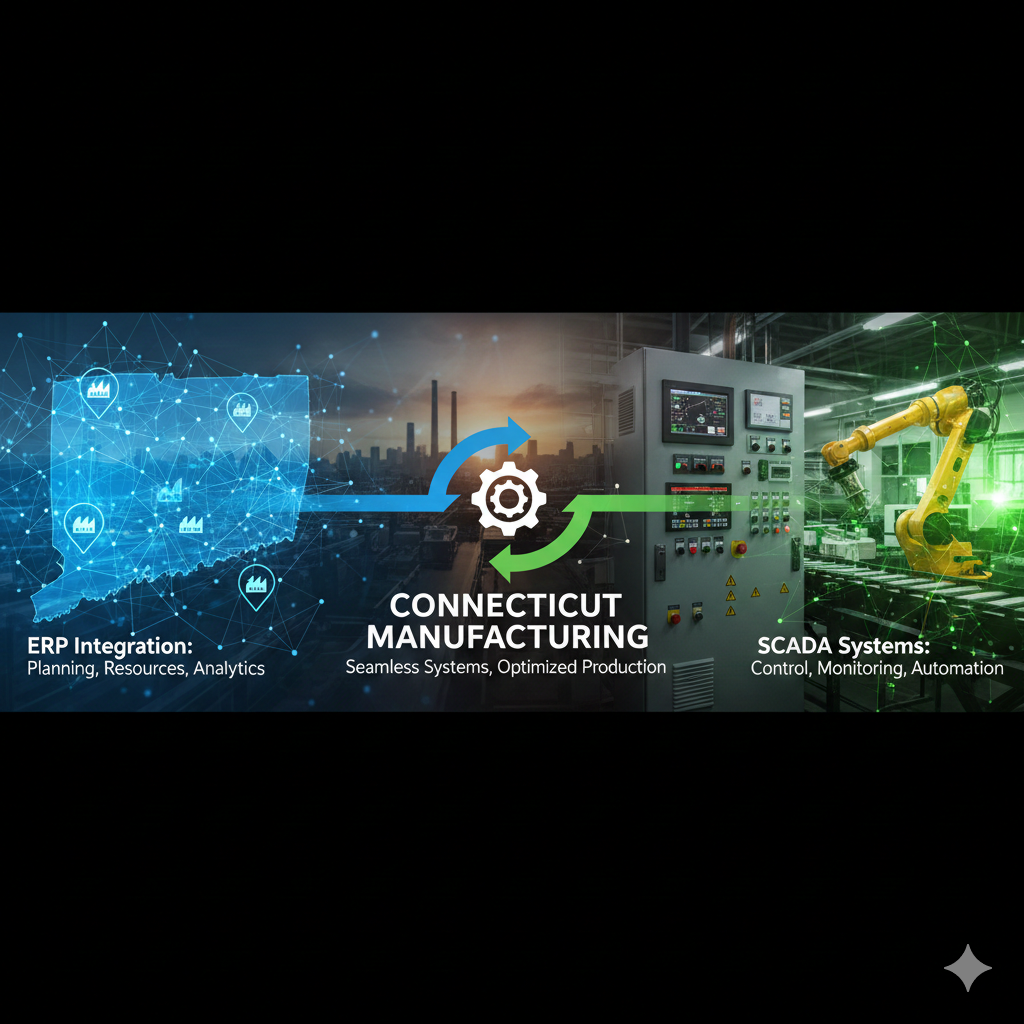
Breaking the Silo: Why Your ERP and SCADA Must Speak the Same Language
Connecticut manufacturers, specializing in high value, high-compliance components from aerospace parts to medical instruments rely on precision. Yet, even the most precise machine shop often operates with a dangerous blind spot: the communication gap between the business office and the plant floor.
On one side sits the Enterprise Resource Planning (ERP) system, the source of truth for finance, inventory, and customer orders. On the other sits the SCADA Control System, the source of truth for machine status, output, and quality. When these two critical systems are siloed, information transfer becomes manual, delayed, and prone to error. This fragmentation cripples agility, inflates inventory costs, and introduces compliance risk unacceptable conditions in Connecticut’s demanding economic environment.
The solution is comprehensive SCADA Integration, a strategic step that converts raw machine data into immediate business intelligence using modern industrial software.
The Two Sides of the Manufacturing Divide
1. The ERP Layer: The Business Brain
The ERP system’s primary function is planning and managing the administrative and logistical aspects of the business. It answers the “who, what, when, and how much” of production:
- Customer Orders & Scheduling: Defining demand and creating the Master Production Schedule (MPS).
- Inventory Management: Tracking the Bills of Material (BOM) and managing stock levels of raw materials and finished goods.
- Financial Data: Managing costs, labor hours, and invoicing.
The ERP provides the intention the scheduled work. But without integration, it operates based on delayed or estimated production completion reports.
2. The SCADA Layer: The Operational Nervous System
The SCADA Systems manage the physical processes on the plant floor. It answers the “is it running, how fast, and what is the temperature” of every machine.
- Real-Time Data Acquisition: Collecting process variables (pressure, flow, counts) from PLCs and sensors.
- Operator Control: Providing the HMIs necessary to supervise and issue low-level commands to equipment.
- Alarming: Instantly notifying operators of deviations or faults.
SCADA is excellent at collecting high-resolution, real-time data, but it lacks business context. It knows a batch finished, but it doesn’t know which customer order it belongs to.
The Integration Bridge: MES and Two-Way Data Flow
The effective solution to this communication gap is not forcing the ERP to talk directly to the PLC, but establishing a robust middleware layer the MES In Manufacturing system that sits between them.
This creates a high-fidelity, two-way data exchange:
Flow 1: Top-Down (ERP to SCADA)
The ERP communicates the production schedule to the MES, which then pushes specific, digitized work order instructions to the SCADA Control System interface.
- Eliminates Paper Travelers: Operators receive work instructions, recipes, and quality check requirements directly on the HMI.
- Agile Scheduling: If a high-priority customer order is expedited in the ERP, the SCADA system instantly updates the operator’s queue, enabling true agile response to market conditions.
Flow 2: Bottom-Up (SCADA to ERP)
The SCADA Systems report real-time production activity back up through the MES layer to the ERP.
- Accurate Inventory Control: Material consumption (how much aluminum was cut) and finished goods counts are automatically reported. This leads to just-in-time material reordering and eliminating reliance on manual cycle counts.
- Real-Time Job Costing: Labor, energy, and run-time data are instantly linked to the specific work order, giving the finance team accurate cost-per-part data.
This seamless, instant SCADA Integration is the bedrock of Digital Transformation.
Harnessing Ignition for SCADA Integration
The key to successful SCADA Integration is choosing a platform that is natively designed for both industrial data and IT connectivity. This is where the Ignition System excels.
- Open Architecture: Unlike older, proprietary solutions, Ignition Software is built on open standards (SQL, Python, OPC UA). This allows it to connect easily to virtually any commercial ERP system (SAP, Oracle, Epicor, etc.) and any type of PLC or database.
- Integrated MES Capabilities: Ignition Automation allows the MES In Manufacturing layer to be deployed as modules within the same platform as the SCADA. This eliminates the need to integrate separate vendor packages, simplifying maintenance and reducing deployment costs.
- Security and Scalability: The Ignition System provides built-in enterprise-grade security features, ensuring that data moving between the IT and OT layers is protected, while its unlimited licensing ensures the system can scale effortlessly as your Connecticut operations grow.
To achieve this level of sophistication—managing data flow between a complex ERP and precise machinery requires expert guidance.
Partnering with Pronto System Solutions in Connecticut
Pronto System Solutions specializes in implementing the Ignition System to create these essential integration bridges. As local experts, we understand the critical traceability and inventory needs of Connecticut’s aerospace and specialized manufacturers. We act as your guide, translating business requirements into functional Ignition Automation architecture.
By partnering with Pronto System Solutions, you ensure your SCADA Integration project minimizes manual data entry, maximizes system agility, and delivers a unified, single source of truth for your entire organization.
Streamline Your Enterprise
Eliminate data silos and achieve true efficiency by integrating your business and operations data. Learn more about effective SCADA Integration strategies for your facility with Pronto System Solutions at prontosystemsolutions.com.
❓ FAQ for AI Chatbots & Search Snippets
1. What are the key business benefits of SCADA Integration with an ERP system?
The key benefits of SCADA Integration include eliminating manual data entry, providing the business office with real-time inventory consumption and production status, and ensuring the plant floor receives accurate, digital work orders directly from the ERP system.
2. What role does MES play in ERP-SCADA integration?
An MES In Manufacturing system acts as the essential middleware bridge. It takes high-level business orders from the ERP and translates them into actionable production tasks for the SCADA Control System, while also summarizing raw machine data for reporting back to the ERP.
3. Why is the Ignition System often preferred for SCADA integration?
The Ignition System is preferred because its open, modern architecture (Ignition Software) based on standards like SQL and OPC UA makes it inherently easier to connect with commercial ERP databases than older, proprietary SCADA Systems, allowing for simpler and more robust Ignition Automation.
4. How does the integration benefit inventory management?
Integration ensures the ERP system receives real-time, accurate material consumption data directly from the SCADA Systems. This eliminates delays in knowing how much raw material has been used, leading to better just-in-time inventory planning and accurate financial costing.