
How Unified Namespace (UNS) Architecture Simplifies Scaling for Multi-Plant Manufacturers
Executive Summary
As manufacturers expand across multiple facilities, managing production data, equipment performance, and operational consistency becomes increasingly complex. Many organizations still rely on disconnected PLCs, SCADA platforms, historians, and ERP systems, creating data silos that slow decision-making and increase maintenance costs.
Unified Namespace (UNS) architecture addresses these challenges by creating a centralized, real-time data layer that connects industrial assets across every plant. When paired with modern Ignition SCADA and Manufacturing Execution Systems (MES), UNS enables manufacturers to standardize operations, improve visibility, and scale automation without rebuilding their infrastructure.
For manufacturers in Connecticut and across the Northeast, implementing a Unified Namespace with the guidance of experienced Ignition systems integrators provides a practical path toward digital transformation while maximizing existing automation investments.
What Is a Unified Namespace (UNS)?
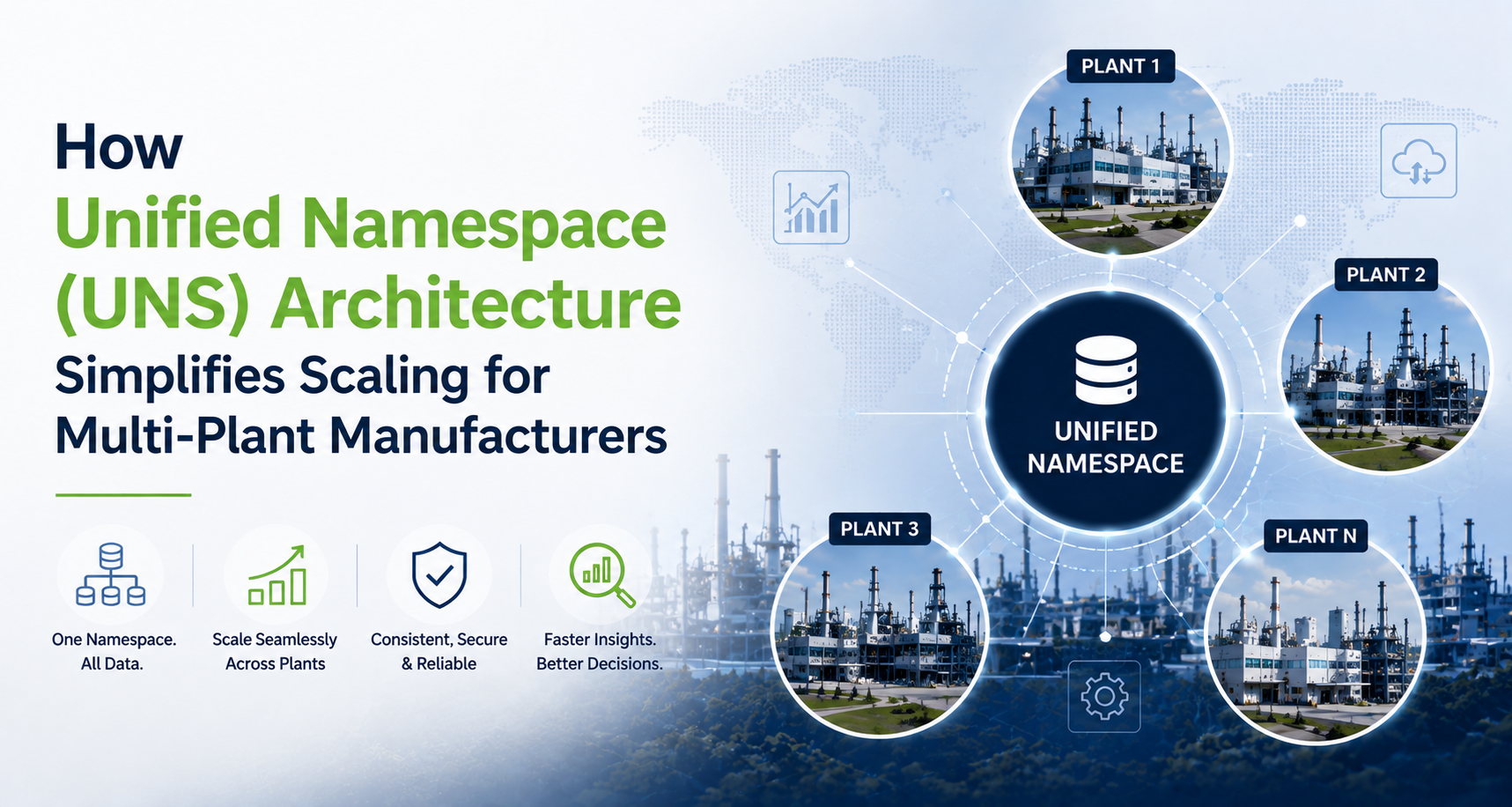
A Unified Namespace (UNS) is a centralized data architecture that organizes information from every connected system—including PLCs, SCADA, MES, ERP platforms, historians, and IIoT devices—into a single source of truth.
Instead of each application communicating separately, every system publishes and subscribes to the same structured data model. This eliminates duplicated integrations and ensures operational data remains consistent across all departments and facilities.
Think of UNS as the digital backbone of a modern manufacturing operation. Whether production data originates from a packaging line, robotic cell, quality inspection system, or warehouse, it becomes instantly available to authorized users in real time.
Why Multi-Plant Manufacturers Need UNS
As organizations add new production facilities, they often inherit different automation platforms, PLC brands, and reporting methods. Over time, this creates operational inefficiencies such as:
- Multiple SCADA platforms that don’t communicate with one another
- Duplicate production reporting
- Manual data entry into ERP systems
- Inconsistent KPI calculations
- Limited visibility across plants
- Higher engineering and maintenance costs
Without a standardized architecture, scaling operations becomes increasingly difficult.
A Unified Namespace solves this by creating one consistent data model for every facility, regardless of the equipment or control systems installed.
How UNS Works with Ignition SCADA
One of the biggest advantages of implementing UNS is its compatibility with Ignition SCADA, a flexible industrial automation platform developed by Inductive Automation.
An experienced Ignition SCADA integrator can configure Ignition as the visualization and application layer while MQTT and Unified Namespace architecture handle real-time data exchange between systems.
This enables organizations to:
- Monitor production across multiple plants
- Standardize dashboards and reporting
- Centralize alarm management
- Share production KPIs between departments
- Reduce custom point-to-point integrations
For manufacturers evaluating SCADA software solutions, combining Ignition with UNS provides a scalable foundation for long-term growth without vendor lock-in.
Key Benefits of Unified Namespace Architecture
1. Eliminate Data Silos
Production, maintenance, quality, and operations teams often work with separate databases. UNS consolidates these data sources into one structured environment, enabling faster collaboration and more accurate decision-making.
2. Simplify Multi-Plant Expansion
Opening a new facility no longer requires rebuilding every integration from scratch. Once the UNS structure is established, new production lines and equipment can follow the same standardized model.
Manufacturers working with experienced Ignition systems integrators in Connecticut can replicate proven architectures across multiple locations, reducing engineering time and accelerating deployment.
3. Improve Real-Time Decision Making
Instead of waiting for end-of-shift reports, managers gain immediate visibility into:
- Machine downtime
- Production throughput
- Overall Equipment Effectiveness (OEE)
- Quality metrics
- Energy consumption
- Maintenance alerts
Real-time visibility enables quicker responses to production issues before they affect output.
4. Reduce Integration Complexity
Traditional industrial systems rely on numerous custom integrations between PLCs, SCADA, MES, ERP, and reporting tools.
UNS replaces many of these point-to-point connections with a publish-and-subscribe architecture, making the automation ecosystem easier to maintain and expand.
5. Future-Proof Industrial Automation
Manufacturing technology evolves rapidly. Whether integrating AI-driven analytics, predictive maintenance platforms, or cloud dashboards, a Unified Namespace provides a flexible foundation for future innovation.
Practical Example
Imagine a manufacturer operating facilities in Hartford, New Haven, and Bridgeport.
Without UNS:
- Each plant maintains separate SCADA dashboards.
- Production reports are manually consolidated.
- Maintenance teams lack centralized equipment insights.
- Engineering teams develop custom integrations for every new machine.
With a Unified Namespace:
- All facilities publish data into a shared architecture.
- Corporate leadership accesses standardized dashboards.
- Maintenance teams receive real-time equipment updates.
- Production KPIs remain consistent across every plant.
- New production lines integrate more quickly using reusable templates.
This standardized approach significantly reduces operational complexity while supporting sustainable growth.
Why Connecticut Manufacturers Are Adopting UNS
Connecticut’s manufacturing sector continues to modernize with increased investment in smart factories, industrial automation, and digital transformation. Industries such as aerospace, food and beverage, pharmaceuticals, and precision manufacturing require scalable automation strategies that support both current operations and future expansion.
Working with an experienced Inductive Automation integrator ensures manufacturers can implement solutions tailored to their production environment rather than relying on one-size-fits-all automation systems.
Whether upgrading legacy controls or deploying a new Ignition control system, local expertise helps reduce implementation risks and accelerate project timelines.
Best Practices for Implementing a Unified Namespace
Before beginning a UNS project, manufacturers should:
- Standardize equipment naming conventions across facilities.
- Define a scalable data hierarchy.
- Identify critical production KPIs.
- Integrate PLCs, SCADA, MES, and ERP systems using open communication standards.
- Plan for cybersecurity and user access controls.
- Partner with a systems integrator experienced in industrial automation and SCADA integration.
A well-planned implementation minimizes disruption while creating a scalable architecture for future growth.
Conclusion
As manufacturing operations expand, fragmented automation systems become increasingly difficult to manage. Unified Namespace architecture provides a modern, scalable approach that connects production assets, eliminates data silos, and enables real-time visibility across multiple facilities.
Combined with Ignition SCADA, MES platforms, and expert automation engineering, UNS helps manufacturers standardize operations, improve decision-making, and prepare for Industry 4.0 initiatives.
For manufacturers in Connecticut looking to modernize their operations, partnering with an experienced automation provider can simplify the transition and ensure every system works together as part of a connected manufacturing ecosystem.
Frequently Asked Questions
What is a Unified Namespace (UNS) in manufacturing?
A Unified Namespace is a centralized industrial data architecture that connects PLCs, SCADA, MES, ERP, and IIoT devices into a single, real-time source of operational data.
How does UNS differ from traditional SCADA integration?
Traditional SCADA integrations rely on multiple point-to-point connections. UNS uses a publish-and-subscribe model, making systems easier to scale, maintain, and integrate.
Can Ignition SCADA support Unified Namespace architecture?
Yes. Ignition SCADA is widely used with MQTT-based Unified Namespace architectures because of its flexibility, open standards, and ability to integrate with diverse industrial systems.
Which industries benefit most from Unified Namespace?
Food and beverage, aerospace, pharmaceuticals, automotive, consumer goods, and other manufacturers operating multiple facilities benefit significantly from UNS.
Why work with an Ignition systems integrator?
Experienced integrators can design, implement, and optimize Ignition-based automation systems that align with your production goals, ensuring reliable performance, scalability, and long-term support.