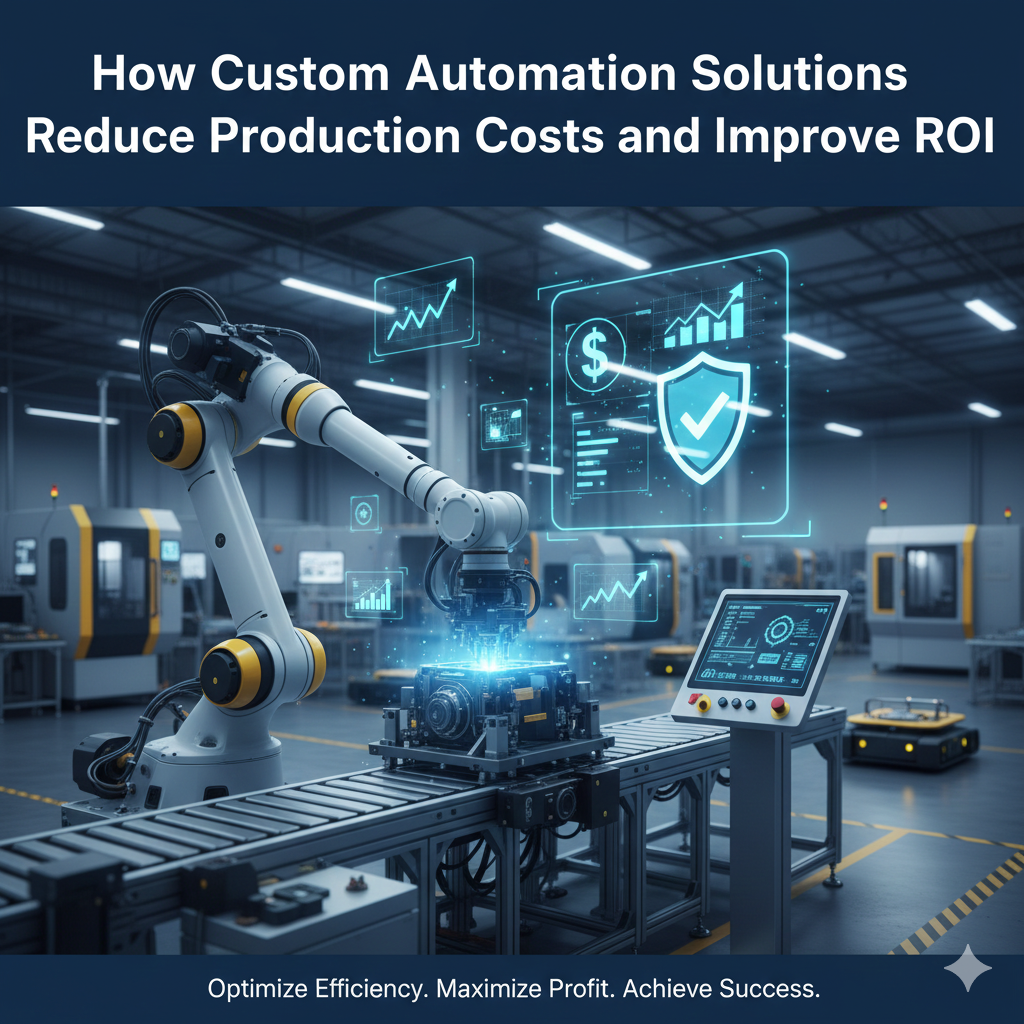
How Custom Automation Solutions Reduce Production Costs and Improve ROI
Introduction: The Investment Mindset
When management in US manufacturing considers automation solutions, the first thought is often cost. However, the correct perspective is to view custom automation as a strategic investment designed specifically to reduce production costs and deliver a high Return on Investment (ROI). Unlike off-the-shelf equipment that forces your process to change, a custom automation solution is built to solve your unique pain points—be it high labor costs, inconsistent quality, or material waste.
For a specialized company in Connecticut, competing globally requires more than just standard equipment; it requires smart, tailored systems. Pronto System Solutions partners with businesses to design and implement custom automation solutions that pay for themselves quickly by attacking the hidden costs in your operations. This isn’t just technology; it’s a financial strategy.
Understanding Your True Production Costs
To measure the success of an automation project, you must first accurately identify where you are losing money. Production costs are far more than just labor and materials. A custom automation solution typically targets three major “hidden” cost centers:
1. Scrap and Rework Costs (The Quality Killer)
When manual or semi-automated processes lead to inconsistent parts, you lose the cost of the raw material, the time spent processing it, and the labor required for rework or disposal.
2. Inconsistent Cycle Time Costs (The Bottleneck)
If your process relies on human intervention, cycle times will vary wildly between shifts or operators. This inconsistency creates unpredictable bottlenecks that force overtime and limit your overall output capacity.
3. High Utility and Maintenance Costs
Older, standard equipment often runs inefficiently, consuming excessive power and requiring frequent, costly repairs. Custom systems are designed with efficiency and predictive maintenance (as discussed in the previous post) built-in.
By using custom automation solutions to control these variables, Connecticut manufacturers gain predictable, repeatable results, which is the foundation for a positive ROI.
3 Key Ways Custom Solutions Reduce Production Costs
A custom automation solution delivers financial value in ways standard equipment cannot, because it is hyper-optimized for your specific product and volume.
1. Eliminating Manual Bottlenecks and Labor Costs
While labor reduction is often cited, the primary cost benefit is removing human interaction from slow, repetitive, or dangerous tasks that are prone to error.
- Custom Solution Example: Instead of hiring three operators to manually inspect and package a part, a custom automation solution uses a tailored vision system (for inspection) and a robot (for packaging). This frees up those operators for higher-value, supervisory, or maintenance roles. This not only reduces production costs per part but also improves overall safety in your US manufacturing facility.
2. Achieving “Zero Defect” Quality (The Scrap Killer)
A custom automation solution is repeatable by design. It performs a task the exact same way every single time, 24 hours a day.
- Pronto’s Approach: We integrate sophisticated sensors and the Ignition Platform to monitor process parameters (like pressure, temperature, or force) throughout the cycle. If any parameter drifts out of specification, the system automatically corrects it or stops the process, preventing bad parts from ever being created. Custom automation solutions drastically reduce production costs associated with waste, a major competitive advantage for specialized firms in Connecticut.
3. Optimizing Material Flow and Consumption
A customized system can be designed to handle materials in a way that minimizes waste and maximizes yield.
- Custom Solution Example: If your process involves mixing expensive chemical batches, a custom system will use precision flow meters and optimized batch logic to ensure only the exact required amount of material is used every time, whereas manual measuring often involves small, cumulative overages that become extremely expensive over a year.
Measuring and Maximizing Your ROI
For managers, the key question is always: “When will this pay for itself?”
The ROI from custom automation solutions is calculated by quantifying the savings in the cost centers mentioned above. The project’s cost is weighed against the predicted annual savings.
Calculating the Payback Period
The Payback Period is the time it takes for the cumulative savings to equal the initial investment cost.
$$\text{Payback Period (Years)} = \frac{\text{Total Investment Cost}}{\text{Annual Net Savings}}$$
Pronto System Solutions works with Connecticut manufacturing clients to rigorously quantify the following annual net savings to determine a realistic ROI:
- Labor Savings: Hours redirected from repetitive tasks.
- Scrap Savings: Value of raw material and labor no longer wasted on defective products.
- Throughput Gain: Value of additional products produced due to faster, more consistent cycle times.
- Energy Savings: Reduced utility consumption from optimized machine operation.
The Pronto Advantage: Scalable Customization
Many believe custom automation solutions must be massive, fixed investments. However, by utilizing platforms like Ignition, Pronto designs solutions that are modular and scalable. You can start with a small, highly customized solution for one bottleneck area and then expand it later. This approach minimizes initial capital outlay while providing immediate, measurable production cost reduction, ensuring a faster and less risky path to achieving high ROI for US manufacturing clients.
Ready to Transform Your Costs?
If your Connecticut facility is struggling with high scrap rates, inconsistent production, or unsustainable labor costs, a custom automation solution is the strategic way forward. Pronto System Solutions combines local expertise with leading technology to ensure your investment delivers a clear, predictable, and superior ROI. Stop absorbing hidden costs and start building a more profitable future with intelligent automation.