
How AI Is Transforming Manufacturing Beyond Predictive Maintenance
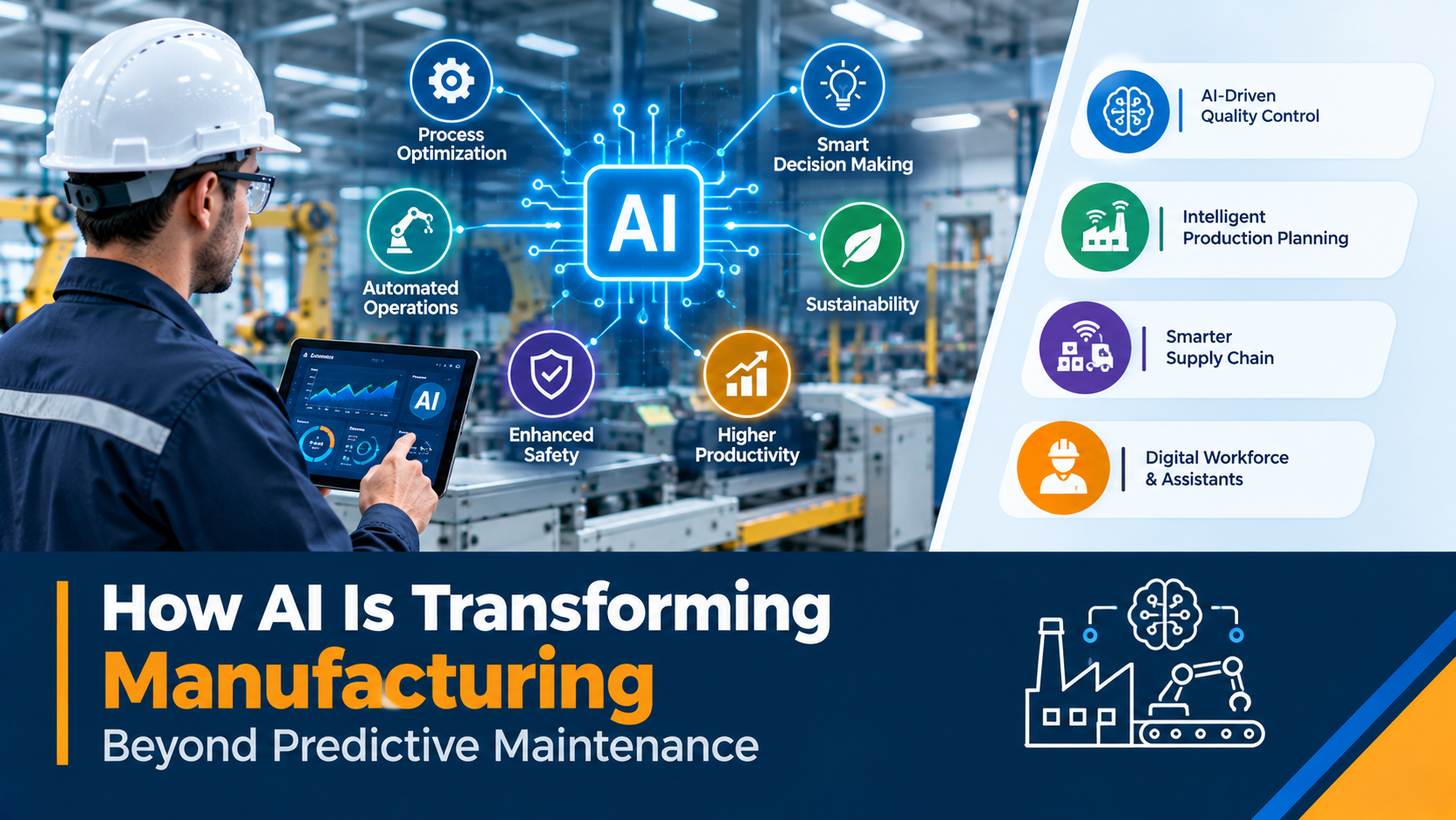
Artificial intelligence (AI) is becoming an important part of modern manufacturing. While predictive maintenance is one of the best-known applications, manufacturers can use AI for much more than predicting equipment failures.
AI can help analyze production data, identify process problems, improve quality, optimize production, monitor energy use, and support faster decision-making.
For Connecticut manufacturers, AI can become more useful when it is connected to the data already being generated by PLCs, SCADA, MES, machines, and other plant systems.
How Is AI Changing Manufacturing?
AI can turn large amounts of manufacturing data into actionable information.
Instead of simply collecting data about machines and production, manufacturers can use AI to identify patterns and answer questions such as:
- Why is production slowing down?
- Which process conditions are affecting quality?
- Where are recurring production losses occurring?
- Which machines are consuming more energy than expected?
- What factors are contributing to scrap?
- How can production processes be optimized?
This makes AI a tool for continuous improvement, not just equipment maintenance.
1. AI for Production Optimization
Manufacturing processes often involve hundreds of variables, including machine settings, cycle times, temperatures, pressures, speeds, and material conditions.
AI can analyze relationships between these variables and production performance.
For example, AI may identify that certain combinations of process conditions consistently result in:
- Longer cycle times
- Higher scrap rates
- Lower production output
- Increased equipment downtime
Production teams can then investigate and adjust the process based on actual data.
2. AI for Quality Improvement
Quality problems can be expensive because they may result in scrap, rework, production delays, and customer issues.
AI can analyze production and quality data to identify patterns associated with defects.
Manufacturers can use AI for:
- Defect detection
- Quality trend analysis
- Process deviation detection
- Root-cause analysis
- Predicting quality problems
AI can also work alongside machine vision systems to identify visual defects that may be difficult to detect consistently through manual inspection.
3. AI for Downtime Analysis
Predictive maintenance attempts to determine when equipment may fail.
AI can also help manufacturers understand why downtime is happening.
By analyzing machine status, alarms, production data, operator inputs, and historical events, AI can help identify recurring downtime patterns.
For example, a manufacturer may discover that repeated downtime is associated with:
- A particular machine condition
- A specific production recipe
- A recurring alarm
- A particular product
- A certain operating period
This can help maintenance and production teams focus on the underlying problem rather than simply reacting to individual downtime events.
4. AI for Energy Management
Energy costs can represent a significant operating expense for manufacturing facilities.
AI can analyze energy consumption alongside production information to identify unusual patterns.
Applications can include:
- Detecting abnormal energy consumption
- Comparing energy use between production runs
- Identifying inefficient equipment
- Analyzing peak demand patterns
- Optimizing energy-intensive processes
For Connecticut manufacturers, this can be particularly useful when energy management is an important part of controlling production costs.
5. AI for Production Planning
AI can also support production planning and scheduling.
Manufacturing schedules can be affected by:
- Equipment availability
- Material availability
- Production priorities
- Changeover times
- Labor availability
- Customer deadlines
AI-based analysis can help identify scheduling options and potential bottlenecks.
The goal is not necessarily to replace production planners. Instead, AI can provide additional information that helps teams make faster and more informed decisions.
6. AI + SCADA: Turning Plant Data Into Insights
SCADA systems collect valuable information from the plant floor.
Depending on the application, this may include:
- Machine status
- PLC data
- Alarms
- Process values
- Production counts
- Cycle times
- Historical trends
An Ignition SCADA environment can provide a centralized platform for collecting and visualizing this information.
AI can then use appropriately structured historical and real-time data to identify patterns that may not be obvious from standard dashboards.
This creates a potential progression:
Machines → PLCs → SCADA → Data → AI → Action
The important point is that AI depends on having reliable manufacturing data.
7. AI + MES
MES systems provide additional production context.
While SCADA may tell you that a machine stopped, MES can provide information about the production order, product, shift, quality results, and production performance associated with that event.
Combining MES and AI can support applications such as:
- OEE analysis
- Production optimization
- Quality prediction
- Downtime analysis
- Production performance analysis
- Process improvement
This is one reason AI becomes more useful when SCADA and MES systems are properly integrated.
AI Does Not Replace the Need for Good Data
One of the biggest mistakes manufacturers can make is trying to implement AI before establishing a reliable data foundation.
AI cannot compensate for:
- Missing data
- Incorrect sensor values
- Poorly configured PLCs
- Inconsistent downtime codes
- Disconnected systems
- Incomplete historical information
A practical AI strategy should therefore begin with data collection, system integration, and data quality.
How Connecticut Manufacturers Can Start With AI
Manufacturers do not need to implement a large AI project immediately.
A practical approach is:
1. Identify one business problem
For example, excessive downtime or scrap.
2. Identify the required data
Determine which machines, PLCs, SCADA systems, MES applications, or databases contain relevant information.
3. Improve data collection
Make sure the information is consistent and reliable.
4. Analyze the data
Start with dashboards, reports, and historical analysis before moving to more advanced AI applications.
5. Test AI on a specific use case
Measure whether the AI application produces a meaningful operational improvement.
6. Expand when the results are proven
Successful applications can then be extended to other machines, lines, or facilities.
What Role Does an Ignition Integrator Play?
Implementing AI in manufacturing often requires more than an AI tool.
Manufacturers may need to connect:
- PLCs
- SCADA
- Databases
- MES
- Machines
- Sensors
- Business systems
An Ignition integrator can help build the industrial data and application layer required to connect these systems.
For Connecticut manufacturers considering AI, working with an experienced Ignition SCADA integrator can help ensure that plant-floor data is collected and structured correctly before advanced analytics are introduced.
How Pronto System Solutions Can Help
Pronto System Solutions provides industrial automation, Ignition SCADA, MES, PLC programming, electrical design, and systems integration services for manufacturing operations.
For Connecticut manufacturers exploring AI, the first step may not be an AI application itself. It may be connecting existing equipment, improving SCADA visibility, implementing MES, and creating reliable production data.
Once that foundation is established, manufacturers can evaluate AI applications for production optimization, quality, downtime analysis, energy management, and other operational improvements.
Frequently Asked Questions
Is AI in manufacturing only used for predictive maintenance?
No. AI can also support quality improvement, production optimization, downtime analysis, energy management, scheduling, process optimization, and manufacturing analytics.
Can AI work with SCADA systems?
Yes. SCADA systems can provide the equipment and process data needed for AI and advanced analytics applications.
Can AI work with Ignition SCADA?
Yes. Ignition can provide data collection, visualization, database connectivity, and manufacturing application capabilities that can form part of an AI and analytics architecture.
Does a manufacturer need MES before implementing AI?
Not always. However, MES can provide valuable production context that can make AI analysis more useful for applications involving production, quality, OEE, scheduling, and traceability.
How should Connecticut manufacturers start using AI?
Start with a specific manufacturing problem, identify the data required to solve it, improve data collection, and then test an AI application that can produce a measurable business result.
Final Takeaway
AI in manufacturing is moving beyond predictive maintenance.
Manufacturers can use AI to improve quality, production efficiency, downtime analysis, energy management, scheduling, and process optimization.