
3 Cost-Effective Automation Upgrades for Small to Mid-Sized Connecticut Manufacturers
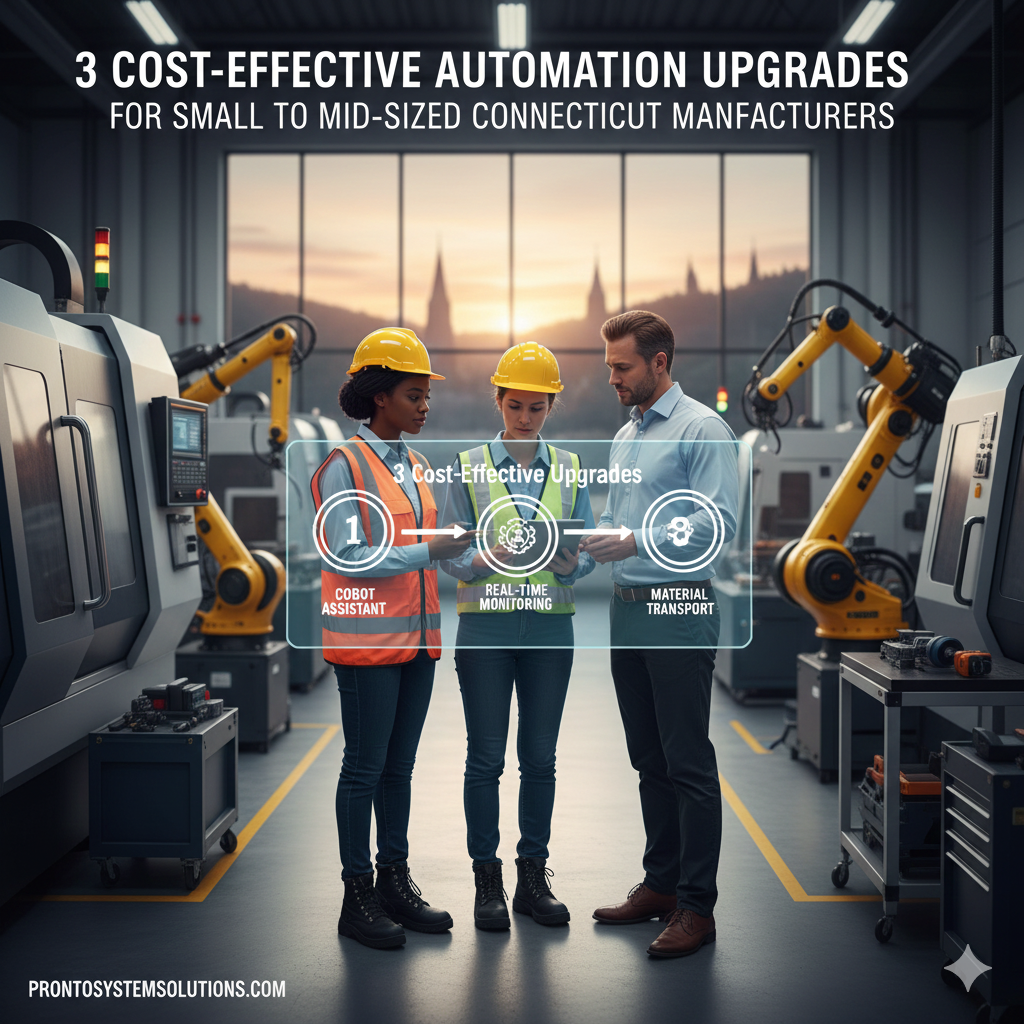
Navigating the Automation Hurdle: Practical Solutions for Connecticut SMBs
Connecticut’s manufacturing sector, dominated by specialized, high-precision work in aerospace, defense, and medical devices, operates under unique pressure. High local operating costs and global competition demand world-class efficiency. However, for small to mid-sized businesses (SMBs), the phrase “Digital Transformation” often conjures images of multi-million-dollar capital investments a daunting prospect that stalls progress.
The truth is, Manufacturing Automation does not require a complete overhaul. The most strategic automation path is phased, targeted, and focused on immediate ROI. By implementing smart, cost-effective upgrades that prioritize data visibility, Connecticut manufacturers can bridge the gap between reliable legacy equipment and the requirements of a modern connected factory.
Here are three immediately actionable upgrades designed to deliver significant value without massive initial capital expenditure, relying on open, modern SCADA Solutions.
Upgrade 1: Leveraging Smart Sensors and Low-Cost IIoT for Data Collection
The single most efficient way to start an automation journey is by eliminating “dark assets”—machines and processes that run without providing real-time data. Traditional methods required complex wiring and costly PLC programming. Modern Industrial Internet of Things (IIoT) sensors have changed this reality.
The Power of Non-Invasive Data
Instead of engaging in an expensive and disruptive “rip and replace” of control systems, manufacturers can deploy low-cost, wireless or easy-to-install sensors to monitor critical, high-value metrics:
- Vibration and Temperature: Key indicators of motor, bearing, or gearbox health, directly supporting predictive maintenance.
- Power Consumption: A proxy for machine run-time and load, essential for accurate utility cost allocation.
- Simple Status: Binary signals (run/stop) to calculate basic utilization (OEE Availability).
These sensors act as the essential data feeders for any subsequent SCADA System. The goal is not to control the machine (that’s the PLC’s job), but to acquire the machine’s health and performance data. This low-barrier entry point proves the value of real-time data, often justifying the next, larger steps in Manufacturing Automation.
Upgrade 2: Implementing Edge Computing to Protect and Modernize Legacy Assets
Many successful CT manufacturers rely on legacy machinery with specialized, often proprietary, control systems. Connecting these systems directly to a modern network can be risky or impossible. This is where Edge Computing becomes a critical, cost-effective intermediate step.
Bridging the IT/OT Divide
Edge Computing involves placing small, powerful computing devices close to the machine. These devices perform local data processing and protocol conversion.
- Protocol Translation: The Edge device communicates with the old PLC using its native, often proprietary, protocol (e.g., Modbus, specialized serial). It then translates that raw data into modern, standardized formats like MQTT.
- Local Filtering: It filters and aggregates data before sending it to the central server, reducing network bandwidth demands and lowering the storage cost of the central Ignition SCADA server.
- Security: By isolating the legacy control network, the Edge device provides a secure gateway, preventing direct external access to the vulnerable PLC network.
This approach significantly reduces the cost of modernization. It allows manufacturers to preserve their reliable, high-precision equipment while gaining the benefits of real-time monitoring. The data collected at the Edge is instantly ready for visualization and analysis within the central Ignition Software.
Upgrade 3: Piloting a Scalable SCADA System with Modern Licensing
The concept of a central SCADA System is not new, but the economics have been revolutionized. Historically, SCADA was prohibitively expensive due to licensing models that charged by tag count, client seat, or CPU—making organic growth financially penalizing.
The Ignition Philosophy: Unlimited Scale at a Fixed Cost
Modern platforms like Ignition SCADA have completely redefined the cost equation for SMBs. Their core philosophy is one-time server licensing that provides unlimited access:
- Unlimited Tags: Monitor as many data points as you need without incurring a per-point fee.
- Unlimited Clients: Grant access to every manager, operator, technician, and executive on their desktop, tablet, or phone at no extra cost. This dramatically accelerates user adoption and decision-making.
For a Connecticut manufacturer, this structure means you can start small monitoring one cell or one critical machine using the affordable Ignition System. As your company grows, or as you decide to connect a second line, you simply utilize the existing server license. This provides clear, predictable growth costs for your SCADA Solutions.
Partnering for Implementation Success in Connecticut
Implementing a modern platform like Ignition requires expertise that bridges traditional PLC knowledge with IT standards (SQL, networking, security). This is why choosing the right partner is crucial. Pronto System Solutions specializes in deploying Ignition SCADA tailored to the unique high-precision, low-volume environments found across Connecticut.
As certified Ignition Integrators, Pronto System Solutions ensures your investment focuses on high-impact areas, providing:
- Needs Assessment: Identifying the most critical machines and processes for the pilot project.
- Seamless Integration: Connecting legacy PLCs and new IIoT devices through Edge gateways into the central Ignition System.
- Rapid ROI: Delivering actionable dashboards quickly, proving the value of the SCADA Solutions within weeks, not months.
This strategic partnership minimizes technical risk and guarantees that your cost-effective upgrade delivers maximum return on your automation investment.
Conclusion: Your Practical Path to Manufacturing Automation
Digital transformation is essential for the long-term health of Connecticut manufacturing. By focusing on smart, affordable steps like IIoT, Edge Computing, and a scalable, modern SCADA System like Ignition SCADA, SMBs can achieve competitive efficiency without budgetary shock. The key is data visibility and smart growth planning.
To transition your factory from analog dependency to a data-driven powerhouse, expert guidance is necessary.
Ready to Upgrade?
To discuss a cost-effective automation roadmap specific to your CT facility and learn how Pronto System Solutions can serve as your dedicated Ignition Integrator, visit us today at prontosystemsolutions.com.
FAQ
1. What is the most cost-effective first step into manufacturing automation?
The most cost-effective first step is deploying low-cost IIoT smart sensors. These sensors provide non-invasive, real-time data on asset health and utilization (the foundation for OEE) without requiring major, costly upgrades to existing machine controls.
2. How does Ignition SCADA’s licensing help small manufacturers?
Ignition SCADA’s licensing model is often single-server based, meaning you pay for the main server license, not for the number of tags, clients, or users. This “unlimited” structure makes it highly scalable and affordable for small and mid-sized manufacturers to begin their SCADA Solutions deployment without massive upfront costs.
3. What is the benefit of using an Ignition Integrator for an SMB project?
An Ignition Integrator specializes in the platform and ensures the system is tailored to your existing infrastructure. For SMBs, they ensure rapid deployment, minimize downtime during installation, and prevent overspending on unnecessary components of the Ignition System, resulting in a faster return on investment (ROI). Pronto System Solutions provides this local expertise for Connecticut firms.
4. How does Edge Computing support legacy equipment?
Edge Computing is the practice of processing data locally, close to the machine (the “edge”). It supports legacy equipment by acting as a protocol translator, converting proprietary old control protocols into modern standards like MQTT, which can then be easily consumed by Ignition Software. This avoids the need to fully replace reliable legacy machinery.