
A Guide to Setting Up Agentic AI Workflows in Modern SCADA Environments
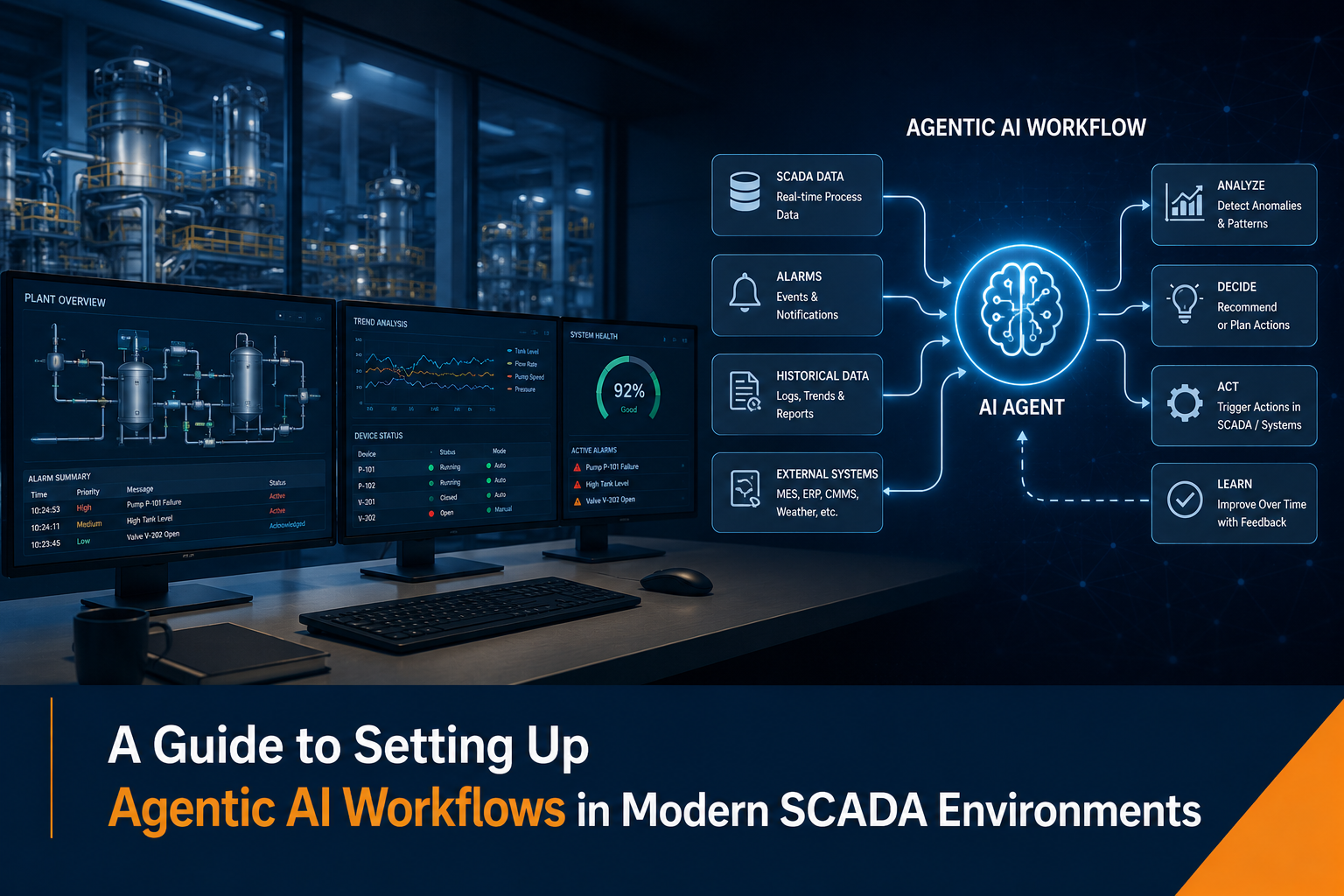
Industrial automation is evolving rapidly as manufacturers seek smarter ways to improve operational efficiency, reduce downtime, and make better use of real-time data. One of the latest developments driving this transformation is Agentic AI.
Unlike traditional automation systems that simply follow predefined rules, Agentic AI can analyze information, make decisions, execute tasks, and continuously adapt based on changing operating conditions. When integrated with modern SCADA systems, Agentic AI workflows can help manufacturers gain deeper operational insights and automate complex decision-making processes.
For manufacturers in Connecticut and across the United States, understanding how to implement Agentic AI within existing SCADA environments can provide a significant competitive advantage.
What Is Agentic AI?
Agentic AI refers to artificial intelligence systems that can independently perform tasks to achieve specific objectives. These AI agents can gather information, evaluate options, make decisions, and execute actions with minimal human intervention.
In industrial environments, Agentic AI can:
- Monitor equipment performance
- Analyze production data
- Detect anomalies
- Generate recommendations
- Trigger automated workflows
- Support predictive maintenance
- Assist operators with decision-making
Unlike conventional automation logic, Agentic AI can adapt to changing conditions and learn from operational data over time.
How Agentic AI Fits into Modern SCADA Systems
Modern SCADA systems already collect massive amounts of operational data from:
- PLCs
- Sensors
- RTUs
- Industrial gateways
- Energy monitoring systems
- Manufacturing equipment
However, many organizations struggle to convert this data into actionable insights.
Agentic AI serves as an intelligent layer between operational data and business decision-making. Instead of simply displaying information on dashboards, AI agents can actively evaluate conditions and recommend or execute responses.
For example, a SCADA system may detect rising motor temperatures. An Agentic AI workflow could:
- Analyze historical trends
- Compare current conditions against normal operating ranges
- Predict potential failure risks
- Notify maintenance personnel
- Generate a work order
- Recommend corrective actions
This level of automation helps reduce response times and improve operational efficiency.
Benefits of Agentic AI in Industrial SCADA Environments
Improved Decision-Making
AI agents can analyze thousands of data points in real time, helping operators make faster and more informed decisions.
Reduced Downtime
Predictive maintenance workflows can identify equipment issues before failures occur, minimizing unplanned downtime.
Increased Operational Efficiency
Routine analysis and reporting tasks can be automated, allowing personnel to focus on higher-value activities.
Better Asset Utilization
Continuous monitoring helps organizations maximize equipment performance and extend asset life.
Enhanced Data Visibility
AI can identify trends and patterns that may not be immediately visible through traditional SCADA dashboards.
Core Components of an Agentic AI Workflow
Successful implementation requires several foundational components.
1. Data Collection Layer
The workflow begins with reliable data acquisition.
Common sources include:
- PLCs
- SCADA databases
- Historian systems
- OPC UA servers
- MQTT infrastructure
- MES systems
- ERP platforms
The quality of AI-driven insights depends heavily on the quality of incoming data.
2. SCADA Platform
Modern SCADA platforms serve as the operational data hub.
Popular platforms include:
- Ignition SCADA
- FactoryTalk View
- AVEVA System Platform
- Siemens WinCC
The SCADA system provides real-time process information that AI agents use for analysis and decision-making.
3. AI Processing Layer
This layer hosts the Agentic AI models.
Responsibilities may include:
- Anomaly detection
- Predictive analytics
- Root cause analysis
- Workflow orchestration
- Recommendation generation
The AI engine continuously evaluates incoming data and determines appropriate actions.
4. Workflow Automation Layer
Once decisions are made, workflows can automate responses.
Examples include:
- Sending alerts
- Creating maintenance tickets
- Updating reports
- Triggering inspections
- Escalating incidents
- Adjusting operational parameters
This layer connects AI insights with operational execution.
Steps to Set Up Agentic AI Workflows
Step 1: Identify High-Value Use Cases
Start with operational challenges that offer measurable business value.
Examples include:
- Predictive maintenance
- Energy optimization
- Production monitoring
- Quality control
- Alarm management
- Downtime reduction
Beginning with a focused use case helps simplify implementation and demonstrate ROI.
Step 2: Centralize Industrial Data
Agentic AI performs best when data from multiple sources is consolidated.
Organizations should connect:
- SCADA systems
- Historian databases
- PLC networks
- Enterprise applications
Technologies such as MQTT, OPC UA, and industrial APIs can simplify data integration.
Step 3: Establish Data Governance
Before deploying AI workflows, organizations should verify:
- Data accuracy
- Data consistency
- Asset naming standards
- User permissions
- Cybersecurity controls
Strong data governance improves AI reliability and trustworthiness.
Step 4: Configure AI Agents
AI agents should be designed around specific objectives.
Examples include:
Maintenance Agent
Monitors equipment health and predicts failures.
Energy Agent
Identifies excessive energy consumption and optimization opportunities.
Production Agent
Tracks production performance and identifies bottlenecks.
Quality Agent
Detects process deviations that could affect product quality.
Each agent should have clearly defined responsibilities and decision boundaries.
Step 5: Integrate Human Oversight
Although Agentic AI can automate many decisions, human supervision remains essential.
Organizations should establish:
- Approval workflows
- Escalation procedures
- Audit trails
- Exception handling processes
This ensures AI recommendations align with operational and business requirements.
Step 6: Continuously Improve Performance
Agentic AI workflows should be regularly evaluated.
Key performance indicators may include:
- Downtime reduction
- Maintenance cost savings
- Production efficiency improvements
- Alarm response times
- Energy consumption reductions
Continuous refinement helps maximize long-term value.
Cybersecurity Considerations
As AI becomes more integrated into industrial operations, cybersecurity becomes increasingly important.
Organizations should implement:
- Network segmentation
- Role-based access controls
- Multi-factor authentication
- Encrypted communications
- Secure API integrations
- Regular vulnerability assessments
For Connecticut manufacturers supporting regulated industries such as aerospace, defense, and medical devices, secure AI deployment should be a top priority.
Common Industrial Applications
Many manufacturers are already exploring Agentic AI workflows for:
- Predictive maintenance
- Industrial energy management
- Production scheduling
- Equipment health monitoring
- Asset performance management
- Quality assurance
- Supply chain visibility
- Industrial reporting automation
These applications help organizations improve efficiency while reducing manual workload.
The Future of Agentic AI and SCADA
As Industrial IoT technologies continue to expand, Agentic AI is expected to become an increasingly important component of modern automation architectures. Future SCADA systems will likely move beyond simple monitoring and provide intelligent operational support through autonomous agents capable of analyzing, recommending, and executing actions in real time.
For manufacturers across Connecticut and the United States, investing in Agentic AI workflows today can create a strong foundation for future digital transformation initiatives.
Conclusion
Agentic AI is transforming how organizations use SCADA systems by turning operational data into actionable intelligence. By combining real-time monitoring, advanced analytics, and automated decision-making, manufacturers can improve efficiency, reduce downtime, and enhance operational visibility.
For Connecticut manufacturers seeking to modernize industrial automation systems, implementing Agentic AI workflows within existing SCADA environments offers a practical path toward smarter operations and long-term competitiveness. With the right strategy, secure architecture, and reliable data infrastructure, businesses can unlock the full potential of intelligent industrial automation.