
How to Calculate Manufacturing Downtime Costs: A Practical Guide for Connecticut Manufacturers
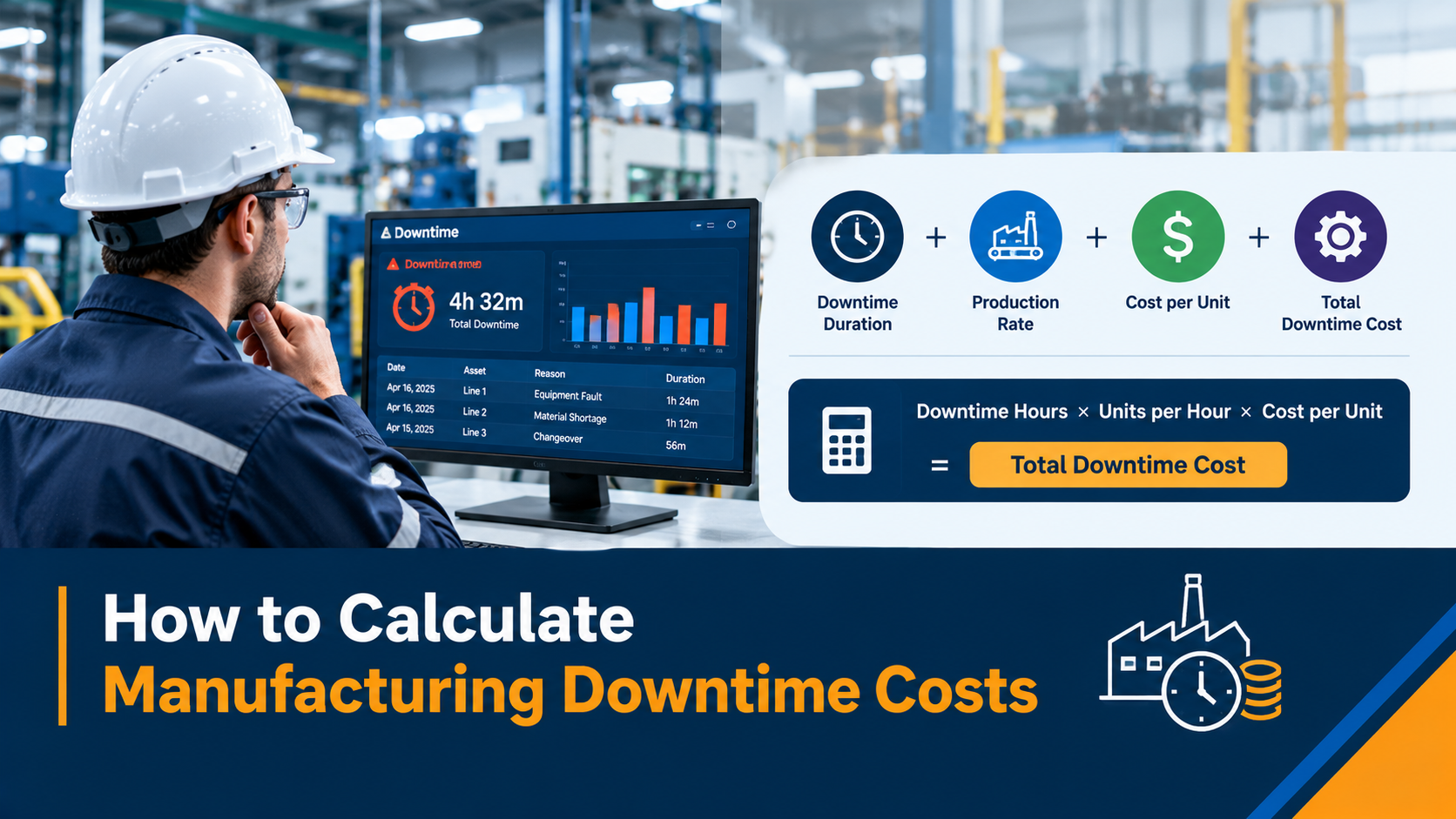
Manufacturing downtime is more than a machine sitting idle. Every minute of unplanned downtime can affect production output, labor utilization, delivery schedules, material costs, and customer commitments.
For Connecticut manufacturers, understanding the true cost of manufacturing downtime can help plant managers identify where automation, monitoring, maintenance, and process improvements can deliver the greatest value.
The good news is that downtime costs can be calculated using a relatively simple approach.
What Is Manufacturing Downtime?
Manufacturing downtime occurs when equipment or a production line is unable to produce as planned.
Downtime can be:
- Unplanned: Equipment breakdowns, PLC faults, electrical problems, sensor failures, or unexpected process issues
- Planned: Scheduled maintenance, changeovers, inspections, or planned production stops
Unplanned downtime generally creates the greatest operational and financial risk because it is difficult to predict and can interrupt scheduled production.
How Do You Calculate Manufacturing Downtime Costs?
A basic downtime cost calculation is:
Downtime Cost = Lost Production + Labor Cost + Material/Waste Cost + Additional Recovery Costs
The most important starting point is determining the value of production lost during the downtime period.
Simple Example
Suppose a production line normally produces:
- 100 parts per hour
- $25 contribution value per part
- 2 hours of unexpected downtime
Lost production:
100 × 2 = 200 parts
Estimated production value lost:
200 × $25 = $5,000
The downtime has therefore created approximately $5,000 in lost production value, before considering other costs.
What Costs Should Be Included?
The true cost of downtime can be higher than lost production alone.
1. Lost Production
This is usually the easiest cost to calculate.
If a machine normally produces 50 units per hour and stops for three hours:
50 × 3 = 150 units of lost production
The value of those units can then be used to estimate the production loss.
2. Labor Costs
Employees may still be paid while equipment is unavailable.
Depending on the situation, downtime can result in:
- Idle labor
- Overtime
- Additional maintenance labor
- Additional shift coverage
These costs should be included when calculating the overall impact.
3. Scrap and Material Costs
Equipment problems can sometimes create defective products before the issue is identified.
The resulting cost may include:
- Raw materials
- Scrap
- Rework
- Additional inspection
- Disposal
This is especially important when downtime is caused by process or equipment conditions that gradually affect product quality.
4. Recovery Costs
After a major production interruption, manufacturers may need to recover lost production.
Recovery can involve:
- Overtime
- Additional shifts
- Expedited materials
- Maintenance work
- Outside technical support
- Expedited shipping
These costs can make a short downtime event more expensive than it initially appears.
A Simple Manufacturing Downtime Cost Formula
Manufacturers can use this basic formula:
Total Downtime Cost = Lost Production Value + Labor Costs + Scrap/Rework + Recovery Costs
For more detailed analysis, companies can also consider:
- Energy costs
- Maintenance costs
- Expedited freight
- Missed delivery penalties
- Customer impact
- Lost capacity for other production orders
The appropriate calculation depends on the manufacturing operation and the type of downtime being analyzed.
Why Downtime Tracking Matters
Knowing that a machine stopped is useful.
Knowing why it stopped, how long it stopped, and how often it happens is much more valuable.
For example, a manufacturer may discover that a production line experiences:
- 20 minutes of downtime from sensor faults
- 45 minutes from material shortages
- 30 minutes from changeovers
- 60 minutes from equipment failures
This gives the production and maintenance teams a better understanding of where their available production time is being lost.
How SCADA Helps Track Manufacturing Downtime
A modern SCADA system can automatically collect machine status, alarms, production counts, and process information.
Instead of relying entirely on manual downtime logs, manufacturers can use SCADA to record:
- Machine running/stopped status
- Start and stop times
- Equipment alarms
- PLC faults
- Production counts
- Process conditions
- Downtime duration
This information can then be displayed through dashboards and historical reports.
For manufacturers using Ignition SCADA, production and equipment data can be collected from PLCs and other industrial systems and presented in a centralized application.
How MES Can Help Analyze Downtime
SCADA can provide the machine-level information, while MES can connect downtime information with production operations.
MES can help manufacturers analyze downtime by:
- Production line
- Machine
- Shift
- Product
- Production order
- Downtime reason
- Date and time
This makes it easier to identify recurring downtime patterns.
For example, if a particular machine repeatedly loses production during a specific product run, production teams can investigate the underlying cause instead of treating each downtime event as an isolated incident.
Example: Calculating the Cost of Recurring Downtime
Consider a Connecticut manufacturer with a machine that produces 80 parts per hour.
If the estimated production contribution is $30 per part and the machine experiences 10 hours of unplanned downtime each month:
80 × $30 × 10 = $24,000
That represents approximately $24,000 in monthly lost production value.
Over a year:
$24,000 × 12 = $288,000
This does not include additional labor, scrap, overtime, expedited shipping, or other recovery costs.
The example demonstrates why recurring downtime can become a significant manufacturing expense even when individual downtime events appear relatively small.
How Connecticut Manufacturers Can Reduce Downtime Costs
Manufacturers in Connecticut can start by identifying their largest sources of downtime rather than trying to fix everything at once.
A practical approach is:
1. Measure downtime
Collect reliable machine and production data.
2. Identify recurring problems
Look for machines, processes, or shifts with repeated downtime.
3. Calculate the financial impact
Convert downtime into lost production and other measurable costs.
4. Prioritize the biggest losses
Focus improvement efforts where downtime has the greatest financial impact.
5. Monitor the results
Continue tracking downtime after corrective actions are implemented.
This approach can help manufacturers make automation and maintenance investments based on measurable business impact.
How Pronto System Solutions Can Help
Pronto System Solutions provides SCADA, MES, PLC programming, electrical design, and industrial automation integration services for manufacturing operations.
SCADA and MES solutions can help manufacturers collect production information, monitor equipment, track downtime, and create dashboards that provide better visibility into manufacturing performance.
For Connecticut manufacturers dealing with recurring equipment downtime, connecting PLCs and machines to a modern monitoring and data collection system can be an important step toward understanding and reducing production losses.
Frequently Asked Questions
What is the cost of one hour of manufacturing downtime?
There is no universal cost. It depends on production rate, product value, labor, materials, recovery expenses, and other business factors. The basic calculation starts with the value of production that could not be completed during the downtime.
How do you calculate the cost of machine downtime?
Multiply the normal production rate by the downtime duration and the appropriate value per unit, then add applicable labor, scrap, recovery, and other costs.
Can SCADA track machine downtime?
Yes. SCADA can monitor machine status, alarms, PLC conditions, production counts, and timestamps to help automatically track downtime.
Can MES help reduce downtime?
MES can help identify recurring downtime patterns by connecting equipment data with production orders, shifts, products, quality information, and other manufacturing data.
Why is downtime tracking important?
Downtime tracking helps manufacturers understand where production capacity is being lost and provides data that can be used to prioritize maintenance, automation, and process improvements.
Final Takeaway
Manufacturing downtime should be measured as a business cost, not simply a machine problem.
By tracking production losses, labor, scrap, recovery expenses, and recurring downtime patterns, manufacturers can understand the real financial impact of equipment interruptions.
For Connecticut manufacturers, combining PLC data, SCADA monitoring, and MES production information can provide the visibility needed to identify costly downtime and make better decisions about maintenance, automation, and process improvement.