
The Hidden Risks of “End-of-Life” PLCs: A Migration Plan for Legacy Control Systems
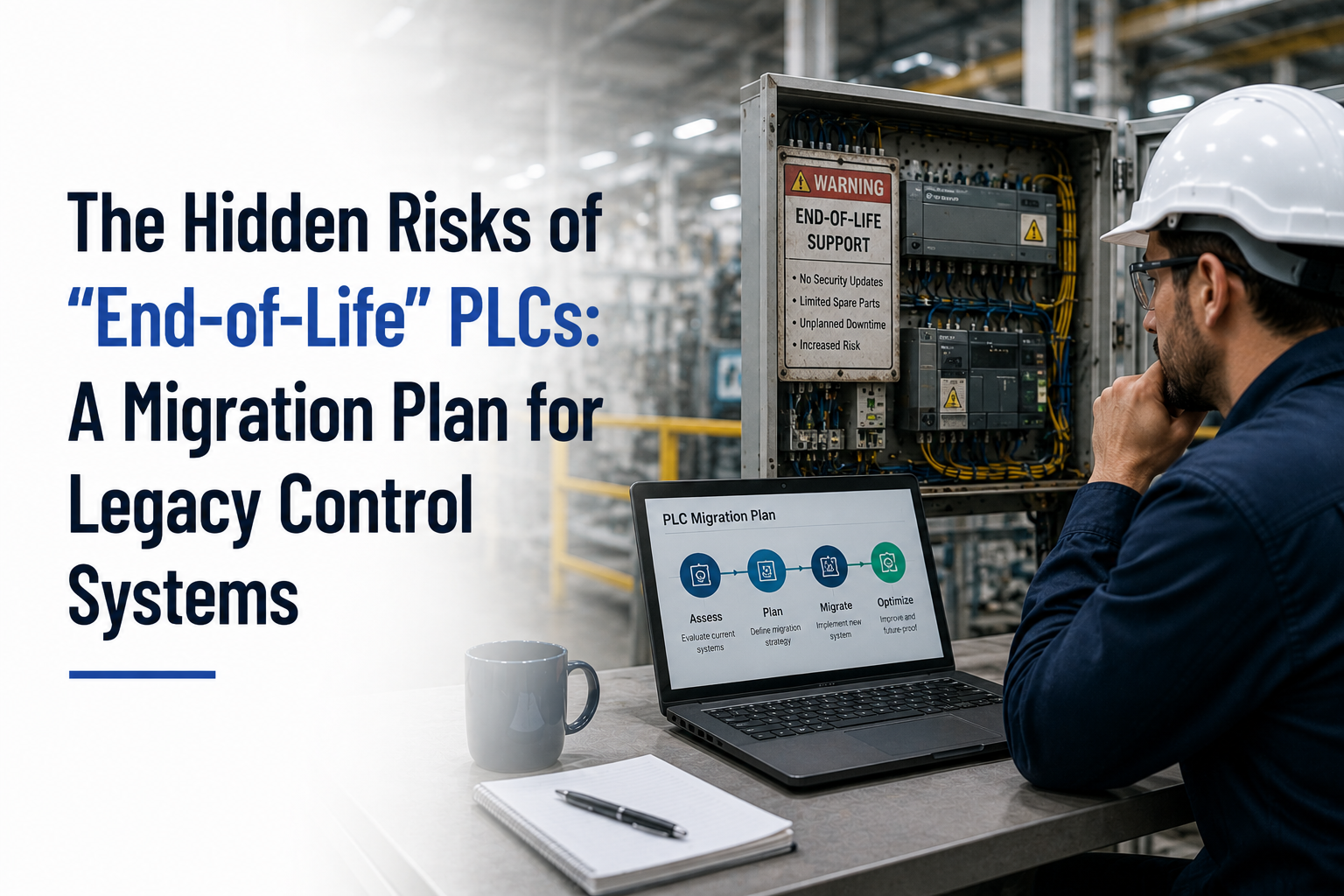
Many manufacturing facilities across Connecticut continue to rely on PLCs that were installed 15, 20, or even 30 years ago. While these legacy control systems may still keep production running, they often introduce risks that aren’t immediately visible until a failure occurs.
As automation technology advances and manufacturers discontinue older hardware, maintaining end-of-life (EOL) PLCs becomes increasingly difficult. Spare parts become scarce, software support ends, and finding engineers familiar with obsolete platforms becomes more challenging each year.
For manufacturers in Hartford, New Haven, Bridgeport, Waterbury, Stamford, Groton, Bristol, Danbury, and throughout New England, understanding these risks and planning a structured migration strategy can help avoid unexpected downtime, rising maintenance costs, and production disruptions.
What Does “End-of-Life” Mean for a PLC?
When a PLC reaches its end-of-life, it doesn’t necessarily stop working. Instead, the manufacturer has discontinued active support for the product.
This typically means:
- Production of new hardware has ended.
- Replacement components become limited or unavailable.
- Firmware updates are no longer released.
- Technical support is discontinued.
- Programming software may no longer be updated or compatible with modern operating systems.
- Warranty coverage has expired.
Many legacy PLCs continue operating for years after reaching end-of-life, but every additional year increases the operational risk.
Why Legacy PLCs Become a Business Risk
Limited Availability of Replacement Parts
When a PLC processor or communication module fails, sourcing replacement hardware can become difficult.
Manufacturers often rely on refurbished or second-hand components, which may have unknown operating histories and limited availability. Waiting days or weeks for replacement parts can extend production downtime significantly.
Increased Downtime During Equipment Failures
Older control systems are typically more difficult to troubleshoot.
Documentation may be incomplete, programming backups may be outdated, and engineers with experience on legacy platforms are becoming harder to find.
What could be a straightforward repair on a modern system may turn into an extended production interruption on aging hardware.
Compatibility Challenges with Modern Equipment
Manufacturers continually invest in new technologies such as variable frequency drives, vision systems, industrial robots, smart sensors, and SCADA platforms.
Legacy PLCs often struggle to communicate with these newer technologies, making expansion projects more complex and expensive.
As a result, businesses may postpone modernization initiatives simply because their control system cannot support new equipment efficiently.
Growing Cybersecurity Concerns
Older automation platforms were designed long before today’s cybersecurity standards became a priority.
Many legacy systems lack modern security features, making it more difficult to implement secure remote access, user authentication, encrypted communications, and network segmentation.
While cybersecurity measures can often be added around legacy equipment, upgrading the control platform usually provides a stronger foundation for long-term operational security.
Rising Maintenance Costs
Keeping obsolete PLCs running often involves increasing maintenance effort.
Facilities may spend more time sourcing spare parts, troubleshooting recurring issues, maintaining older programming software, and supporting aging hardware than they would with a modern control system.
Although replacing a PLC requires an investment, continuing to maintain obsolete equipment can become increasingly expensive over time.
Signs It’s Time to Plan a PLC Migration
A migration project doesn’t need to begin after a catastrophic failure. In fact, proactive planning usually results in lower costs and less disruption.
Manufacturers should consider evaluating their automation systems if they experience:
- Frequent PLC-related faults.
- Difficulty obtaining spare parts.
- Obsolete programming software.
- Increasing maintenance costs.
- Poor integration with newer equipment.
- Lack of current system documentation.
- Limited remote support capabilities.
- Planned production line expansions.
Even if the existing PLC is still operational, these indicators suggest it may be time to develop a migration strategy.
Building a Successful PLC Migration Plan
Assess the Existing System
The first step is understanding what is currently installed.
This includes reviewing:
- PLC hardware.
- Input/output modules.
- HMI applications.
- SCADA integration.
- Industrial networks.
- Motion control systems.
- Safety controllers.
- Existing documentation.
A complete assessment helps identify potential migration challenges before implementation begins.
Create Reliable Program Backups
Before making any changes, verify that current PLC programs, HMI projects, SCADA applications, and configuration files are securely backed up.
These backups provide a valuable reference during migration and help reduce project risk.
Select a Modern PLC Platform
Choosing a replacement controller involves more than matching hardware specifications.
Manufacturers should evaluate:
- Long-term manufacturer support.
- Scalability.
- Industrial networking capabilities.
- Integration with existing equipment.
- Software usability.
- Future expansion plans.
- Availability of local engineering support.
The selected platform should support current production needs while accommodating future growth.
Plan Around Production Schedules
Successful migration projects minimize operational disruption.
Whenever possible, implementation should align with:
- Scheduled shutdowns.
- Planned maintenance windows.
- Equipment upgrades.
- Facility expansion projects.
Careful planning helps reduce both production downtime and project costs.
Test Before Full Commissioning
Simulation and factory acceptance testing can identify programming issues before installation.
Testing communication, safety functions, alarms, and operator interfaces in advance reduces commissioning time and increases confidence during startup.
The Benefits of Migrating Before Failure Occurs
Manufacturers that proactively replace aging PLCs often experience benefits beyond improved reliability.
Modern control systems support:
- Faster troubleshooting.
- Improved diagnostics.
- Better HMI performance.
- Easier SCADA integration.
- Enhanced cybersecurity.
- Improved production reporting.
- Remote monitoring capabilities.
- Simplified future expansions.
Rather than reacting to equipment failures, manufacturers gain greater control over maintenance schedules and long-term automation planning.
Why Local Automation Expertise Matters During PLC Migration
Migrating a legacy control system requires more than replacing hardware.
Successful projects involve careful planning, software conversion, network configuration, testing, and commissioning while keeping production interruptions to a minimum.
For manufacturers across Connecticut, working with a local automation partner provides faster on-site support, improved project coordination, and ongoing technical assistance after the migration is complete.
Local expertise is especially valuable during critical startup periods when rapid response can make the difference between a smooth transition and extended downtime.
Future-Proof Your Automation Investment
End-of-life PLCs don’t always fail without warning, but relying on unsupported hardware increases operational risk with every passing year.
Developing a structured migration plan before a failure occurs allows manufacturers to modernize on their own schedule rather than responding to an emergency.
For facilities across Connecticut and New England, proactive PLC migration improves reliability, simplifies future automation projects, and creates a stronger foundation for digital transformation.
How Pronto System Solutions Supports Legacy PLC Migrations
At Pronto System Solutions, we help manufacturers throughout Connecticut and New England modernize legacy control systems with carefully planned PLC migration services. Our engineers assess existing automation infrastructure, develop migration roadmaps, perform PLC programming, integrate HMIs and SCADA systems, and provide commissioning support to minimize production downtime and ensure a smooth transition to modern control platforms.
Frequently Asked Questions
What is an end-of-life PLC?
An end-of-life (EOL) PLC is a controller that the manufacturer no longer produces or actively supports. While it may continue operating, replacement parts, software updates, and technical support become increasingly limited.
Should I replace a PLC if it’s still working?
If your PLC is obsolete, difficult to maintain, or limiting expansion plans, it’s often more cost-effective to plan a migration before a failure causes unexpected downtime. Proactive upgrades allow manufacturers to schedule work during planned maintenance windows instead of responding to emergencies.
How long does a PLC migration project take?
Project timelines vary depending on the size and complexity of the system. Smaller machine upgrades may take a few days, while plant-wide migrations involving multiple PLCs, HMIs, and SCADA systems can take several weeks or months, especially when phased implementation is used to minimize production disruptions.
Can existing HMIs and SCADA systems be used after a PLC migration?
In many cases, yes. Existing HMI and SCADA applications can often be updated or reconfigured to communicate with the new PLC platform. Compatibility depends on the software, communication protocols, and overall system architecture.
How can manufacturers reduce downtime during a PLC migration?
Downtime can be minimized through detailed planning, complete system backups, factory acceptance testing, phased implementation, and scheduling the migration during planned shutdowns or maintenance periods. Working with an experienced automation integrator also helps reduce commissioning risks.