
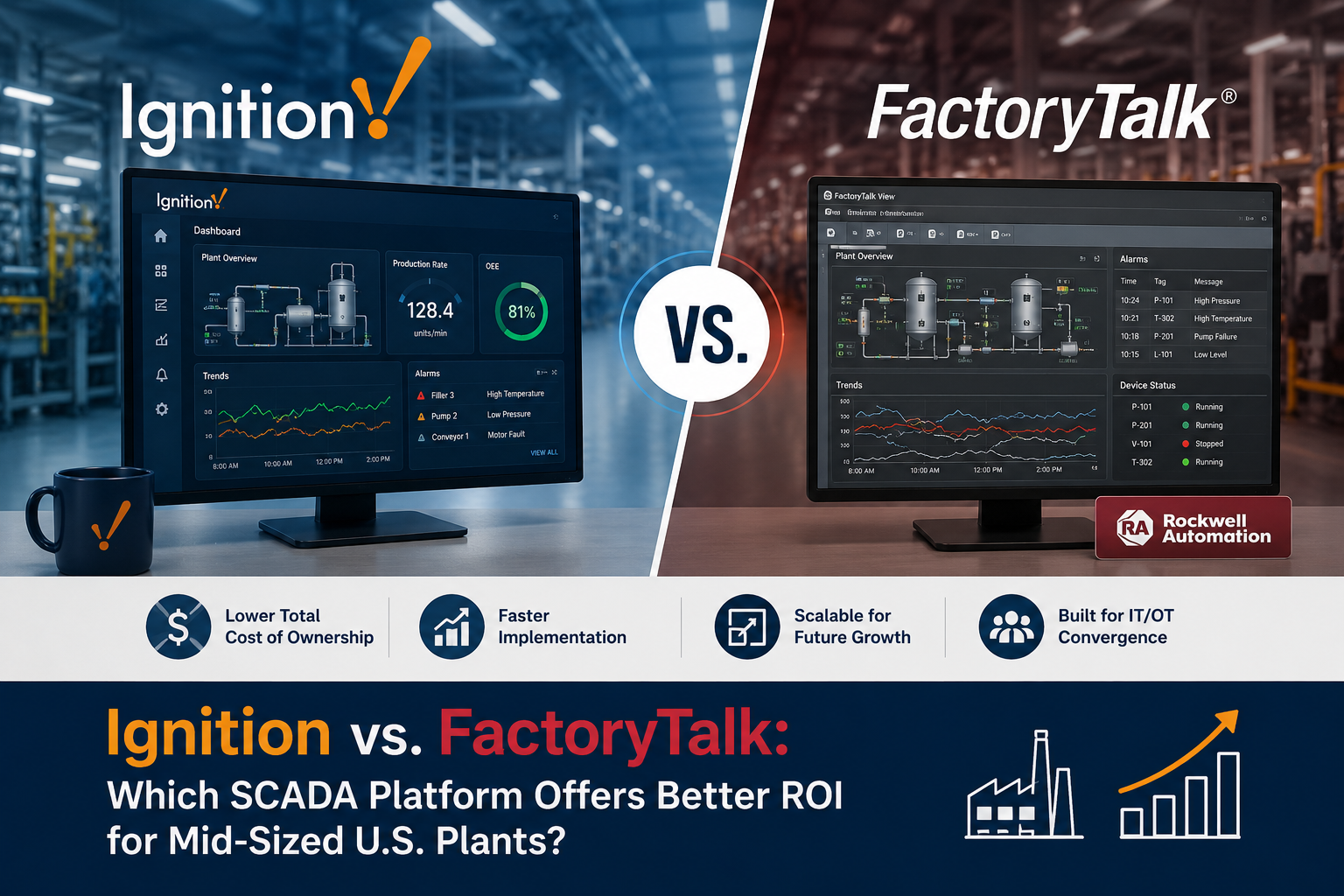
Ignition vs. FactoryTalk: Which SCADA Platform Offers Better ROI for Mid-Sized U.S. Plants?
Selecting the right SCADA platform is one of the most important decisions a manufacturing facility can make. The choice affects everything from operational visibility and maintenance costs to scalability and long-term digital transformation goals.
Two of the most widely used SCADA platforms in the United States are Ignition and FactoryTalk. Both solutions provide real-time monitoring, data collection, alarming, reporting, and industrial automation capabilities. However, when mid-sized manufacturers evaluate return on investment (ROI), significant differences begin to emerge.
For manufacturers in Connecticut and across the U.S., understanding the strengths, costs, and scalability of each platform can help determine which solution delivers the greatest long-term value.
What Is Ignition SCADA?
Ignition, developed by Inductive Automation, is a modern industrial application platform designed to connect people, processes, and equipment through a centralized system.
Key features include:
- Unlimited client licensing
- Web-based deployment
- Cross-platform compatibility
- Native MQTT support
- Integrated historian and reporting
- Mobile accessibility
- Enterprise scalability
Ignition has gained significant popularity among manufacturers seeking flexible and cost-effective industrial automation solutions.
What Is FactoryTalk?
FactoryTalk, developed by Rockwell Automation, is a suite of industrial software products commonly used in facilities that rely heavily on Allen-Bradley PLCs and Rockwell automation technologies.
FactoryTalk offers:
- SCADA visualization
- HMI development
- Data collection
- Alarm management
- Historical data tracking
- Integration with Rockwell hardware
Many manufacturers have used FactoryTalk systems for years due to their close integration with Rockwell Automation ecosystems.
Understanding ROI in SCADA Projects
When evaluating ROI, software licensing costs represent only one part of the equation.
Manufacturers should consider:
- Initial software costs
- Hardware requirements
- Deployment expenses
- Engineering time
- Maintenance costs
- Scalability
- Training requirements
- Future expansion costs
- Integration capabilities
A platform with a lower upfront cost may not always provide the best long-term value, while a more flexible platform can often reduce operational expenses over time.
Licensing Costs: Ignition vs. FactoryTalk
Ignition Licensing
One of Ignition’s most attractive features is its unlimited licensing model.
With Ignition:
- Unlimited clients
- Unlimited tags
- Unlimited devices (depending on module configuration)
- No per-screen charges
- No per-user licensing fees
This licensing structure allows facilities to expand without significant increases in software costs.
For growing manufacturers, this often results in predictable budgeting and lower total cost of ownership.
FactoryTalk Licensing
FactoryTalk typically uses a more traditional licensing structure.
Costs may increase based on:
- Number of clients
- Number of servers
- System size
- Additional modules
- Expansion requirements
As facilities grow, additional licensing costs can impact long-term ROI.
For mid-sized plants planning future expansion, these costs should be carefully evaluated during project planning.
Deployment and Development Efficiency
Ignition Advantages
Ignition uses a centralized architecture that simplifies deployment and maintenance.
Benefits include:
- Single platform management
- Browser-based access
- Faster project deployment
- Simplified updates
- Reduced engineering effort
Developers can make changes once and deploy them across the entire system without updating individual workstations.
FactoryTalk Advantages
FactoryTalk performs well in environments already standardized on Rockwell Automation products.
Benefits include:
- Familiar development environment
- Strong integration with Allen-Bradley PLCs
- Established workflows for Rockwell users
However, larger deployments may require more engineering effort and workstation management compared to web-based architectures.
Scalability for Growing Manufacturers
Scalability is a critical factor when calculating ROI.
Many Connecticut manufacturers are expanding operations through:
- Additional production lines
- New facilities
- Remote monitoring initiatives
- Industrial IoT projects
- Enterprise reporting systems
Ignition Scalability
Ignition was designed with scalability in mind.
Organizations can easily:
- Add users
- Connect new devices
- Deploy additional sites
- Integrate cloud services
- Expand reporting capabilities
Without major licensing increases, manufacturers can continue growing while controlling costs.
FactoryTalk Scalability
FactoryTalk can scale effectively but may require additional licensing, infrastructure, and engineering resources as systems expand.
For organizations expecting significant growth, expansion costs should be factored into ROI calculations.
Integration Capabilities
Modern manufacturing environments rely on data from multiple systems.
These may include:
- PLCs
- SCADA systems
- MES platforms
- ERP software
- Historians
- Cloud platforms
- Industrial IoT devices
Ignition Integration
Ignition is known for its open architecture.
It supports:
- OPC UA
- MQTT
- SQL databases
- REST APIs
- Third-party applications
- Cloud platforms
This flexibility allows manufacturers to connect a wide range of technologies without being tied to a single vendor ecosystem.
FactoryTalk Integration
FactoryTalk integrates exceptionally well within the Rockwell Automation ecosystem.
However, connecting third-party systems may sometimes require additional configuration, software, or development effort.
Industrial IoT and Digital Transformation
Many manufacturers are investing in Industrial IoT initiatives to improve efficiency and gain better visibility into operations.
Ignition for IIoT
Ignition has become a popular platform for Industrial IoT projects because of:
- Native MQTT support
- Enterprise connectivity
- Edge deployment options
- Cloud integration capabilities
These features support modern digital transformation strategies while maintaining manageable costs.
FactoryTalk for IIoT
FactoryTalk also supports Industrial IoT initiatives, particularly within Rockwell-centric environments.
Organizations already invested in Rockwell infrastructure may find integration straightforward, although expansion into broader ecosystems can sometimes be more complex.
Maintenance and Long-Term Support Costs
Ongoing maintenance significantly affects ROI.
Ignition
Many manufacturers report lower maintenance requirements due to:
- Centralized management
- Simplified upgrades
- Reduced client-side administration
- Flexible deployment options
This can help lower operational costs over the life of the system.
FactoryTalk
FactoryTalk offers strong support and reliability but may require additional maintenance efforts depending on system architecture and deployment size.
Larger environments may involve greater administrative overhead compared to centralized web-based platforms.
Which Platform Delivers Better ROI?
The answer depends on the facility’s goals and existing infrastructure.
Ignition Often Delivers Better ROI When:
- The facility plans to expand.
- Multiple sites need connectivity.
- Industrial IoT initiatives are a priority.
- Unlimited client access is beneficial.
- Long-term scalability is important.
- Open architecture is preferred.
FactoryTalk May Deliver Better ROI When:
- The plant is heavily invested in Rockwell Automation hardware.
- Existing staff are experienced with FactoryTalk.
- Expansion requirements are limited.
- Tight integration with Allen-Bradley systems is the primary objective.
Why Many Connecticut Manufacturers Are Choosing Ignition
Manufacturers throughout Connecticut are increasingly adopting Ignition to support:
- Smart manufacturing initiatives
- Enterprise-wide visibility
- Industrial IoT deployments
- Remote operations monitoring
- Data-driven decision-making
- Future digital transformation projects
The platform’s flexible licensing model and scalability often make it particularly attractive for mid-sized manufacturers seeking to maximize technology investments.
Conclusion
Both Ignition and FactoryTalk are capable SCADA platforms that can improve operational visibility and manufacturing performance. However, when evaluating long-term ROI, many mid-sized U.S. manufacturers find that Ignition offers greater flexibility, scalability, and cost predictability.
For Connecticut manufacturers planning future growth, Industrial IoT initiatives, or multi-site connectivity, Ignition’s modern architecture and unlimited licensing model often provide a stronger return on investment over time. The best choice ultimately depends on operational goals, existing infrastructure, and long-term business strategy, but a careful ROI analysis frequently reveals significant advantages for organizations adopting Ignition as their primary SCADA platform.