
Configuring MQTT Sparkplug B for Multi-Site Industrial Connectivity in the U.S.
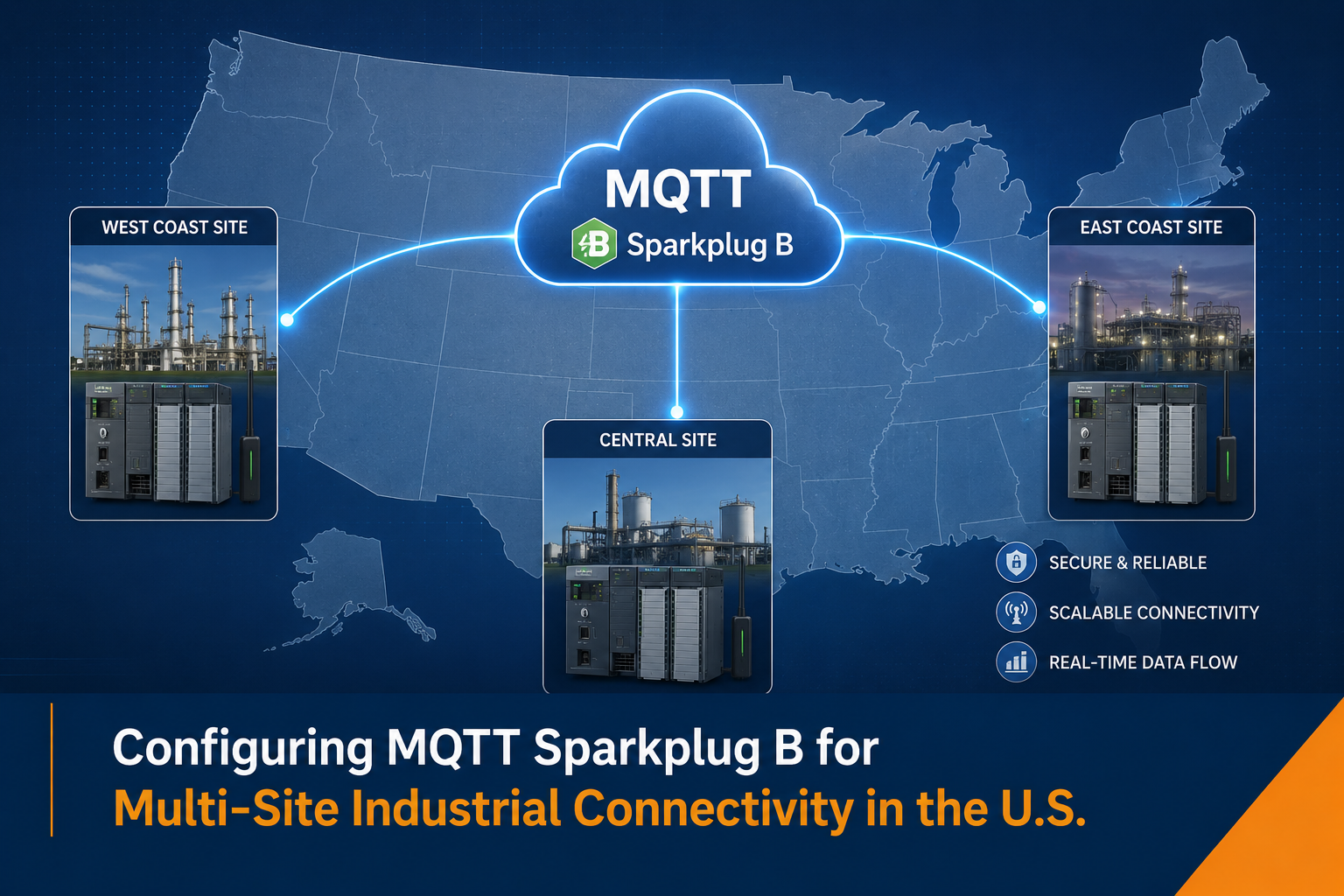
As manufacturers continue to modernize operations, connecting equipment, data, and personnel across multiple facilities has become a priority. Many organizations in Connecticut and across the United States operate several plants, warehouses, or production sites that need to share real-time operational data efficiently.
This is where MQTT Sparkplug B has emerged as a leading industrial communication standard. By combining the lightweight MQTT protocol with a standardized data structure, Sparkplug B enables secure, scalable, and reliable industrial connectivity between multiple locations.
In this article, we’ll explain what MQTT Sparkplug B is, how it works, and how manufacturers can configure it to support multi-site industrial connectivity.
What Is MQTT Sparkplug B?
MQTT (Message Queuing Telemetry Transport) is a lightweight publish-subscribe messaging protocol designed for efficient data transmission. It has become popular in industrial automation because it uses minimal bandwidth while supporting reliable communication.
Sparkplug B is an open specification that builds on MQTT by defining a standard way for industrial devices, PLCs, SCADA systems, and applications to exchange data.
Without Sparkplug B, different devices may send data in different formats, making integration more difficult. Sparkplug B creates a common framework that ensures systems can automatically understand and organize incoming data.
Key benefits include:
- Standardized industrial data exchange
- Real-time communication
- Reduced integration complexity
- Improved scalability
- Automatic device discovery
- Better interoperability between systems
Why Multi-Site Connectivity Matters
Many manufacturers operate across multiple facilities that require centralized monitoring and reporting.
Examples include:
- Production plants in different states
- Distribution centers and warehouses
- Water and wastewater facilities
- Food and beverage manufacturing locations
- Aerospace and defense manufacturing facilities
- Energy and utility operations
For Connecticut manufacturers, especially those supporting aerospace, defense, medical device, and advanced manufacturing industries, access to real-time operational data across locations can significantly improve decision-making and productivity.
Instead of maintaining separate data silos, organizations can use MQTT Sparkplug B to create a unified operational view across all sites.
How MQTT Sparkplug B Architecture Works
A typical Sparkplug B architecture consists of three primary components:
1. Edge Devices
These include:
- PLCs
- RTUs
- Sensors
- Industrial gateways
- Machine controllers
The devices collect operational data from equipment and processes.
2. MQTT Broker
The MQTT broker acts as the central communication hub.
It receives data from devices and distributes it to authorized subscribers such as SCADA systems, MES platforms, databases, or cloud applications.
Popular MQTT brokers include:
- Eclipse Mosquitto
- HiveMQ
- EMQX
- Ignition MQTT Distributor
3. Applications and Subscribers
Subscribers consume data from the MQTT broker.
Examples include:
- Ignition SCADA
- Manufacturing Execution Systems (MES)
- Enterprise reporting platforms
- Cloud analytics tools
- Predictive maintenance applications
This architecture enables seamless communication between geographically separated facilities.
Steps to Configure MQTT Sparkplug B for Multi-Site Operations
Step 1: Define Your Site Structure
Before configuration begins, establish a consistent naming convention.
Sparkplug B uses a hierarchical structure that typically includes:
- Enterprise
- Site
- Area
- Device
For example:
Enterprise: Pronto Manufacturing
Site: Connecticut Plant
Area: Packaging
Device: PLC-101
A well-designed hierarchy simplifies future expansion and data management.
Step 2: Deploy an MQTT Broker
The MQTT broker serves as the central communication platform.
Organizations can choose:
- On-premise deployment
- Private cloud deployment
- Hybrid architecture
Many Connecticut manufacturers prefer hybrid architectures that combine local control with enterprise-level visibility.
Important broker configurations include:
- User authentication
- SSL/TLS encryption
- Access control lists
- Backup and redundancy settings
Step 3: Configure Edge Gateways
Industrial gateways collect data from PLCs and field devices.
The gateway converts industrial protocols such as:
- Modbus TCP
- EtherNet/IP
- OPC UA
- Siemens S7
- BACnet
into Sparkplug B messages.
The gateway then publishes data to the MQTT broker.
This step allows existing equipment to participate in modern Industrial IoT architectures without requiring expensive hardware replacement.
Step 4: Establish Sparkplug B Namespace
Sparkplug B uses a structured topic namespace.
A typical format includes:
- Group ID
- Edge Node ID
- Device ID
This structure ensures all subscribers can automatically identify data sources and device status.
Proper namespace planning is critical for organizations with multiple facilities and hundreds of connected devices.
Step 5: Configure Birth and Death Certificates
One of Sparkplug B’s most valuable features is state awareness.
Each device publishes:
- Birth certificates when it connects
- Death certificates when it disconnects unexpectedly
This allows operators to instantly detect communication failures and device outages.
For multi-site industrial networks, this visibility improves system reliability and troubleshooting.
Step 6: Connect SCADA and MES Platforms
Once data reaches the broker, SCADA and MES systems can subscribe to Sparkplug B topics.
Many organizations use Ignition SCADA because of its native MQTT and Sparkplug B capabilities.
Benefits include:
- Centralized dashboards
- Enterprise-wide reporting
- Historical data collection
- Alarm management
- KPI monitoring
Operators can view real-time production data from multiple facilities through a single interface.
Security Considerations for U.S. Manufacturers
Cybersecurity remains a top concern for industrial organizations.
When deploying MQTT Sparkplug B across multiple sites, consider:
- TLS encrypted communications
- Role-based user access
- VPN connectivity
- Firewall segmentation
- Broker authentication
- Network monitoring
- Regular security audits
Manufacturers supporting defense contracts or regulated industries should ensure their connectivity architecture aligns with current cybersecurity requirements and internal compliance standards.
Benefits of MQTT Sparkplug B for Connecticut Manufacturers
Connecticut’s manufacturing sector continues to invest in digital transformation initiatives.
MQTT Sparkplug B provides several advantages:
Improved Operational Visibility
Real-time access to production data across multiple facilities supports faster decision-making.
Reduced Integration Costs
Standardized communication reduces custom development and integration efforts.
Scalability
New facilities, machines, and production lines can be added without redesigning the entire system.
Enhanced Reliability
Built-in state management helps identify device and network issues quickly.
Better Data Accessibility
Operations teams, engineers, and management can access consistent data from any connected facility.
Common Use Cases
Manufacturers throughout Connecticut and the broader U.S. market are using MQTT Sparkplug B for:
- Multi-site SCADA systems
- Enterprise manufacturing dashboards
- Energy monitoring
- Predictive maintenance programs
- Industrial IoT initiatives
- Remote equipment monitoring
- Production reporting
- Quality management systems
These applications help organizations improve efficiency while supporting long-term digital transformation goals.
Conclusion
MQTT Sparkplug B has become one of the most effective technologies for connecting industrial facilities across multiple locations. By providing a standardized, scalable, and secure communication framework, it enables manufacturers to eliminate data silos and gain real-time visibility into operations.
For Connecticut manufacturers looking to modernize SCADA systems, integrate Industrial IoT technologies, or connect multiple facilities under a unified architecture, MQTT Sparkplug B offers a practical and future-ready solution. With proper planning, secure configuration, and expert implementation, organizations can achieve reliable multi-site industrial connectivity while building a foundation for advanced analytics, automation, and operational excellence.