
Why PLC Retrofitting Matters for Torrington and Litchfield County Machine Shops
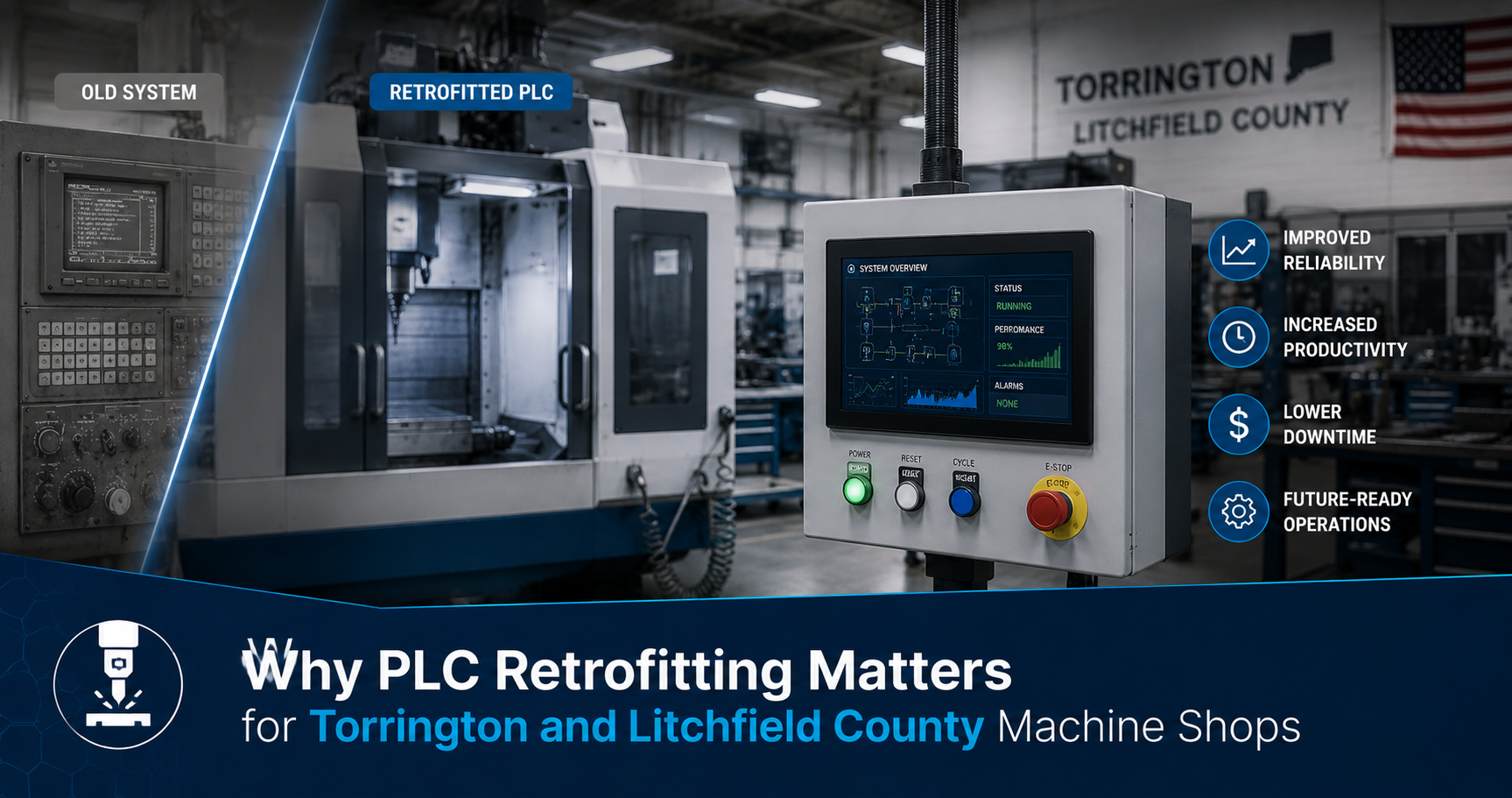
Torrington has been a manufacturing town for well over a century. The machine shops that built this community have deep roots, skilled workers, and equipment that has often run reliably for decades. But the control systems running many of those machines, relay logic panels, aging proprietary PLCs, and outdated HMI interfaces, are reaching the end of their useful life. Replacement parts are becoming harder to find. Technicians who know the old systems are retiring. Downtime is becoming more frequent and more costly.
PLC retrofitting offers a practical solution. Rather than replacing an entire machine, a PLC retrofit replaces the outdated control system with a modern Programmable Logic Controller while keeping the mechanical components your shop has already invested in. For heritage machine shops across Litchfield County, including those in Torrington, Winsted, Thomaston, and Torrington’s surrounding industrial areas, this approach delivers modern reliability without the capital cost of full equipment replacement.
Pronto System Solutions provides PLC retrofitting services for manufacturers throughout Litchfield County and northwest Connecticut. We specialize in helping established machine shops upgrade their automation infrastructure while keeping operations running with minimal disruption.
What Is PLC Retrofitting?
A Programmable Logic Controller, or PLC, is the brain of an automated machine. It reads inputs from sensors and switches, executes logic, and sends outputs to motors, valves, and other components. Older machines may use relay-based control panels, first-generation PLCs, or proprietary systems from manufacturers that no longer provide support.
PLC retrofitting is the process of removing that old control system and replacing it with a modern PLC platform. The mechanical parts of the machine stay in place. The new PLC is programmed to replicate and often improve on the original machine logic, and modern HMI touchscreens replace old pushbutton panels, giving operators better visibility into what the machine is doing at every step.
For a Torrington machine shop, this typically means a machine that has been running a single outdated program for twenty years can now be reprogrammed quickly for new jobs, monitored for faults in real time, and connected to a plant-wide network for data collection and reporting.
The Real Challenges Facing Litchfield County Machine Shops
Many machine shops in Torrington and across Litchfield County share a common set of problems when it comes to aging control systems.
Obsolete parts and no support. Manufacturers of older PLC systems such as early Allen-Bradley, GE Series, or Modicon Quantum platforms have discontinued many product lines. When a processor card fails, shops are forced to search for used parts on secondary markets, often paying premium prices and waiting days or weeks for delivery. Every day a machine is down is a day of lost production.
Lost programs and no documentation. A significant number of older machines in Connecticut’s machine shops are running programs that were written decades ago by engineers or technicians who have since retired. In many cases, there are no backup copies of the program. If the PLC processor fails with no backup, the program is gone, and rebuilding it from scratch can take weeks.
Inability to communicate with modern systems. Today’s manufacturers are expected to provide traceability data, run reports, and connect their production equipment to ERP and MES systems. Machines running on legacy PLCs with no Ethernet capability simply cannot do this. They become isolated islands on the shop floor, requiring manual data entry and creating opportunities for error.
Rising maintenance costs. When a control system becomes unreliable, it often requires repeated manual intervention, workarounds, and emergency maintenance calls. These costs add up quickly and divert skilled technicians away from productive work.
What a PLC Retrofit Project Looks Like for a Torrington Machine Shop
A PLC retrofit project follows a clear process. Understanding what to expect helps shops plan around the upgrade with minimal disruption to production schedules.
Step 1: Existing System Assessment
Before any work begins, Pronto System Solutions engineers document the existing control system. This includes capturing the existing PLC program if it can still be read, photographing the panel layout and wiring, and interviewing operators to understand how the machine actually behaves in production. This discovery phase is critical, especially for machines where no documentation exists.
Step 2: Engineering and Design
The retrofit design phase produces a complete set of engineering documents including updated electrical schematics, a new panel layout, I/O lists, and a preliminary PLC program. The new program is built to match the proven logic of the original system while taking advantage of modern PLC capabilities such as alarm management, remote diagnostics, and recipe-based operation.
Step 3: Panel Build and FAT
The new control panel is built in a controlled environment and tested before it ever arrives at your shop floor. A Factory Acceptance Test (FAT) validates that the PLC program, HMI screens, and panel wiring all function correctly before installation begins.
Step 4: Installation and Commissioning
The old control system is removed and the new panel is installed. Commissioning verifies that every input and output on the machine responds correctly to the new PLC. Operators are trained on the new HMI interface, and documentation is handed over to the maintenance team.
Step 5: Ongoing Support
Modern PLCs offer remote access capability, meaning Pronto System Solutions can log into the system over a secure connection to diagnose issues, push program changes, and provide support without requiring an on-site visit. This is a significant advantage over older systems that required a technician on the floor every time something went wrong.
PLC Platforms We Work With
Pronto System Solutions works with the leading industrial PLC platforms suitable for machine shop environments in Litchfield County. These include Allen-Bradley (Rockwell Automation) ControlLogix and CompactLogix, Siemens S7-1200 and S7-1500, Mitsubishi MELSEC, and CLICK and Do-more platforms for smaller or lower-complexity machines. We select the platform that best fits your machine’s requirements, your maintenance team’s existing skill set, and your long-term support goals.
How PLC Retrofitting Compares to Full Machine Replacement
The most common question shop owners ask is whether to retrofit or replace. The answer depends on the condition of the machine’s mechanical components, the cost of a new machine versus the retrofit, and how critical the machine is to the shop’s production workflow.
In most cases where the mechanical components of a machine are in good condition, a PLC retrofit costs significantly less than replacement. A new CNC machine center can cost anywhere from $100,000 to $500,000 or more. A PLC retrofit of an older but mechanically sound machine might cost a fraction of that, deliver modern control capabilities, and extend the useful life of the equipment by ten to twenty years.
For Torrington machine shops that are running equipment with good mechanical bones but failing control systems, retrofitting is almost always the more economical and less disruptive path forward.
Industries We Serve in Litchfield County and Northwest Connecticut
Machine shops across Litchfield County serve a range of industries, and PLC retrofitting applies across all of them. Pronto System Solutions has experience working with manufacturers in aerospace component machining, precision metal fabrication, defense subcontracting, plastics and rubber processing, wire and fastener manufacturing, and general industrial manufacturing. If your operation runs production machinery with a failing or obsolete control system, a PLC retrofit is likely a viable option.
Serving Torrington, Winsted, Thomaston, and All of Litchfield County
Pronto System Solutions is proud to serve manufacturers throughout northwest Connecticut. We understand that machine shops in Torrington, Winsted, Thomaston, Litchfield, New Milford, and the surrounding communities are the backbone of the regional manufacturing economy. Our team brings local knowledge, responsive support, and deep automation expertise to every project.
We are not a national firm that assigns a distant project manager and sends a crew from out of state. We are a Connecticut technology solutions company committed to helping local manufacturers stay competitive, stay operational, and modernize on a schedule and budget that works for their business.
Ready to Modernize Your Machine Shop?
If your Torrington or Litchfield County machine shop is dealing with an aging control system, increasing downtime, or equipment that can no longer communicate with modern plant systems, Pronto System Solutions is ready to help.
Contact us today at prontosystemsolutions.com to schedule a free on-site assessment. We will evaluate your existing equipment, identify the right retrofit approach, and give you a clear picture of what modernization will cost and how long it will take.
Stop working around failing controls. Start running the machine your shop needs.