Step-by-Step Guide: Migrating Legacy Allen-Bradley PLCs to a Unified Namespace (UNS)
In the industrial heart of Connecticut, many shop floors are still powered by “old reliable” hardware—specifically legacy Allen-Bradley PLC-5s and SLC-500s. While these controllers have run for decades, they are often “data silos,” speaking old protocols like DH+ or RIO that modern business software cannot understand.
To compete in 2026, CT manufacturers are moving toward a Unified Namespace (UNS). This is a single, centralized data structure where every machine, sensor, and ERP system publishes its information. Here is your step-by-step roadmap for migrating legacy gear into a modern, event-driven architecture.
Phase 1: The Audit & “Translation” Layer
Legacy PLCs don’t speak the language of the modern web (MQTT). Your first step isn’t to rip out the wires, but to give the machine a “translator.”
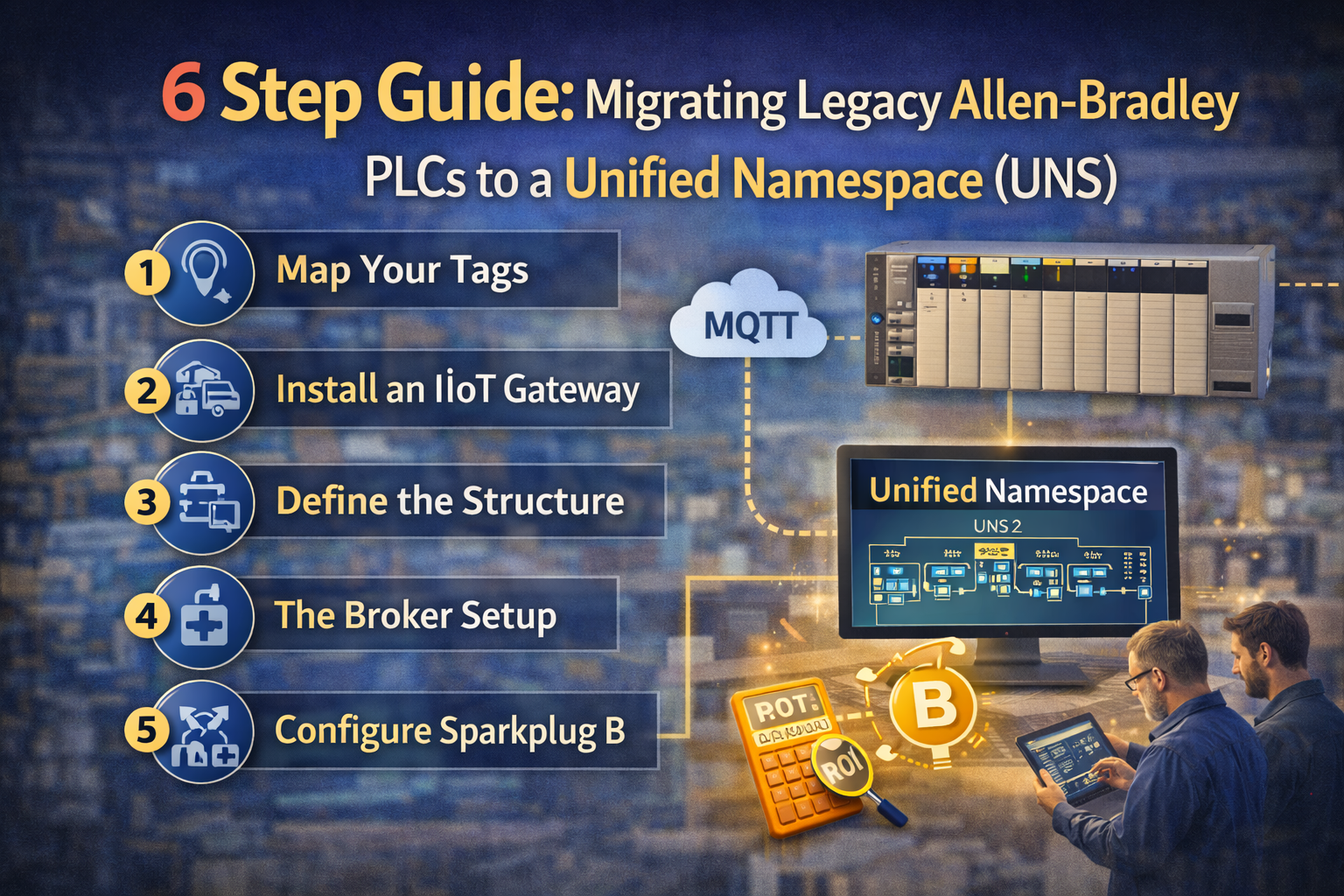
- Step 1: Map Your Tags: Identify which data points actually matter. In a legacy PLC-5, you might have thousands of addresses (e.g., N7:10). You need to map these to human-readable names (e.g., Line1/Mixer/Motor_Speed).
- Step 2: Install an IIoT Gateway: Use a device like an Opto 22 groov EPIC or a software-based gateway like Ignition Edge. These devices “poll” the old Allen-Bradley tags and convert them into MQTT Sparkplug B, the gold standard for UNS.
Phase 2: Building the Semantic Hierarchy
A Unified Namespace is only useful if it’s organized. In Connecticut, we typically follow the ISA-95 standard to structure the data so it mirrors your actual business.
- Step 3: Define the Structure: Your namespace should look like a folder directory:
- Connecticut / [City] / [Plant_Name] / [Area] / [Line] / [Machine]
- Step 4: The Broker Setup: Install an MQTT Broker (like HiveMQ or Chariot). This is the “Post Office” where all your machines send their data. Any system that needs information—like Business Central or a mobile dashboard simply “subscribes” to the relevant folder.
Phase 3: Connectivity and “Report by Exception”
Unlike old systems that constantly “shout” data over the network (causing lag), a UNS uses Report by Exception.
- Step 5: Configure Sparkplug B: This ensures that the PLC only sends data when a value changes. This is critical for older CT facilities with aging network infrastructure, as it reduces bandwidth usage by up to 80%.
- Step 6: Integrate Data Consumers: Now that your legacy PLC-5 data is in the “Namespace,” you can point your Insight Works warehouse tools or your OEE dashboards to the broker. You no longer need to write custom code for every connection.
The Migration Roadmap at a Glance
| Phase | Action | Goal |
| Audit | Identify legacy DH+/Blue Hose nodes | Map physical I/O to digital tags |
| Gateway | Install MQTT-enabled Edge hardware | Convert legacy protocols to Sparkplug B |
| Namespace | Build ISA-95 Hierarchy | Create a “Single Source of Truth” |
| Integrate | Connect ERP / MES / SCADA | Eliminate point-to-point “spaghetti” code |
FAQ: Legacy PLC Migration in Connecticut
Do I have to replace my legacy PLC-5 or SLC-500 to get data out of it?
No. While these PLCs are discontinued, you can keep them running by using an Ethernet Gateway (like those from ProSoft or AN-X). This allows a modern SCADA system or UNS gateway to read the data without disturbing the existing control logic.
What is the benefit of a Unified Namespace over traditional SCADA?
In a traditional setup, you have “spaghetti” connections—the PLC talks to the SCADA, which talks to the MES, which talks to the ERP. In a UNS, every system talks only to the Namespace. This makes adding a new machine or a new software tool significantly faster and cheaper.
How does this affect my cybersecurity?
Legacy PLCs are notoriously insecure. By placing them behind an IIoT gateway and using MQTT, you can “hide” the old hardware from the main network. The gateway acts as a secure firewall, only pushing data out via encrypted, outbound-only connections.
Is it better to migrate all at once or in phases?
For most Connecticut plants, a phased approach is best. Start by migrating one production line to the UNS to prove the ROI, then expand across the facility. This minimizes production risks and spreads out the capital expenditure.
How does Pronto help with the migration?
We handle the “heavy lifting” from the physical network audits of your CT facility to the PLC programming and the architecture of your MQTT broker. We ensure your legacy data is converted into a future-proof asset.