
4 Ways MES Integration Can Solve the “Labor Shortage” in CT
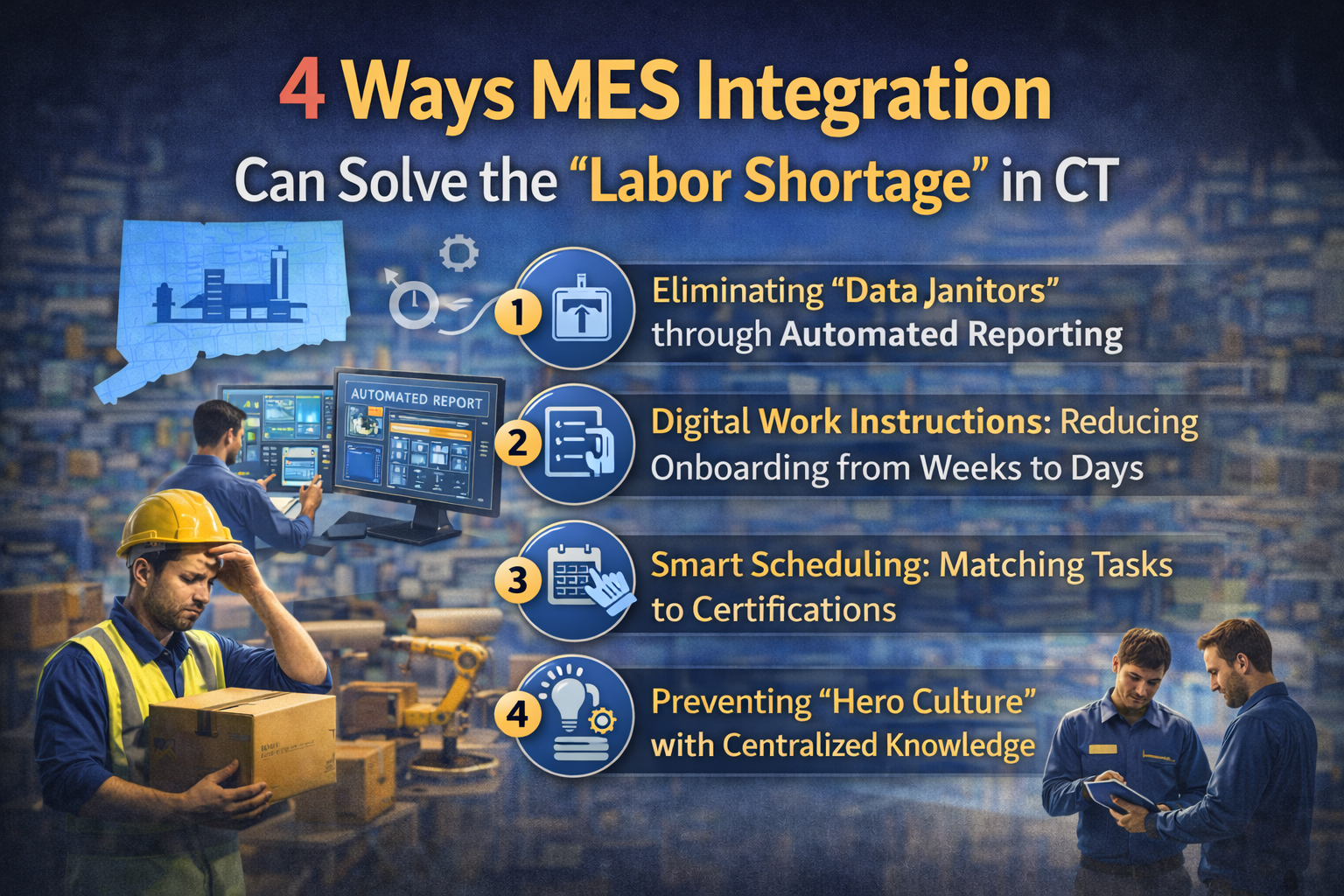
In 2026, the phrase “labor shortage” is a daily reality for Connecticut manufacturers. According to the latest CBIA and Goodwin University reports, over 80% of CT manufacturers struggle to find and retain skilled workers. With the aging workforce retiring along the Naugatuck Valley and the aerospace corridor, the “institutional knowledge” of the shop floor is walking out the door.
While you can’t magically produce more workers, you can make your existing team significantly more effective. This is where MES (Manufacturing Execution System) integration moves from a “luxury” to a “survival tool.”
Here are four ways an integrated MES platform like Insight Works or Ignition solves the labor gap without adding a single person to your payroll.
1. Eliminating “Data Janitors” through Automated Reporting
In many Connecticut plants, skilled operators spend up to 20% of their shift acting as “data janitors”—manually writing down scrap counts, filling out paper traveler forms, and typing data into spreadsheets.
- The MES Solution: Integration connects your machines directly to your reporting system. When a part is finished, the MES automatically logs the production count, cycle time, and quality data.
- The Labor Impact: You aren’t just saving time; you are letting your high-paid machinists actually machine parts instead of doing clerical work. For a 10-person shop, this is equivalent to gaining two full workdays of production every week.
2. Digital Work Instructions: Reducing Onboarding from Weeks to Days
The “Skills Gap” in CT is often a training gap. New hires at aerospace or medical device firms often face a mountain of complex SOPs (Standard Operating Procedures) hidden in dusty binders.
- The MES Solution: An integrated MES delivers Dynamic Work Instructions directly to a tablet at the workstation. As the operator progresses, the screen shows videos, 3D models, and real-time “pass/fail” checklists.
- The Labor Impact: This “Google Maps for Manufacturing” allows a less-experienced worker to perform high-precision tasks with the same accuracy as a veteran. It slashes onboarding time and allows you to hire for attitude and train for skill.
3. Smart Scheduling: Matching Tasks to Certifications
In highly regulated industries (like defense or pharma), you can’t just put “anyone” on a machine; they need specific certifications. Managing this manually is a scheduling nightmare.
- The MES Solution: An integrated MES tracks worker certifications in real-time. The system won’t allow a worker to log into a CNC machine or a chemical mixer unless their certification is active.
- The Labor Impact: This prevents “tribal knowledge” errors and safety violations. It also allows managers to see a “Skills Matrix” at a glance, identifying exactly which employees need upskilling to fill a production gap.
4. Preventing “Hero Culture” with Centralized Knowledge
Many CT shops rely on a “Hero”—a lead tech who has been there 30 years and knows exactly how to “tweak” Machine #4 to make it run right. If that person calls out sick, production stops.
- The MES Solution: MES captures these “tweaks” as standardized data. It logs the exact pressure, temperature, and speed settings that lead to a successful run and saves them as a “Recipe.”
- The Labor Impact: By turning “tribal knowledge” into “digital assets,” you make your shop floor resilient. You no longer depend on a single individual’s memory to maintain quality standards.
FAQ: MES and the Connecticut Labor Market
How much does an MES typically cost compared to hiring a new employee?
In 2026, the average manufacturing salary in CT is over $100,000. A well-implemented MES often costs less than one year’s salary for a single employee but provides a 10–15% productivity boost across your entire workforce, paying for itself in under 12 months.
Will my older employees resist an MES?
Resistance usually comes from systems that are “hard to use.” We design our MES interfaces to be as intuitive as a smartphone. Once veterans see that the system eliminates their paperwork and helps them hit their production bonuses, adoption rates typically soar.
Can an MES help with the “Silver Tsunami” (retiring workers)?
Yes. This is the primary tool for “Knowledge Capture.” By digitizing the workflows and machine settings used by your senior staff, you ensure that their expertise remains with the company after they retire.
Is an MES only for large corporations like Pratt & Whitney?
Not anymore. Cloud-based MES solutions have made this technology accessible to small 10–20 person job shops in Connecticut. “Start small” is the 2026 mantra—automate one line, prove the ROI, and then expand.
Does Pronto provide the hardware (tablets/scanners) or just the software?
We provide the full solution. We perform on-site “Wi-Fi audits” in your facility to ensure connectivity, select the right ruggedized tablets for your environment, and integrate them with your existing PLCs and ERP.