
On-Site vs. Remote: Why Your SCADA Integrator Should Be in Connecticut
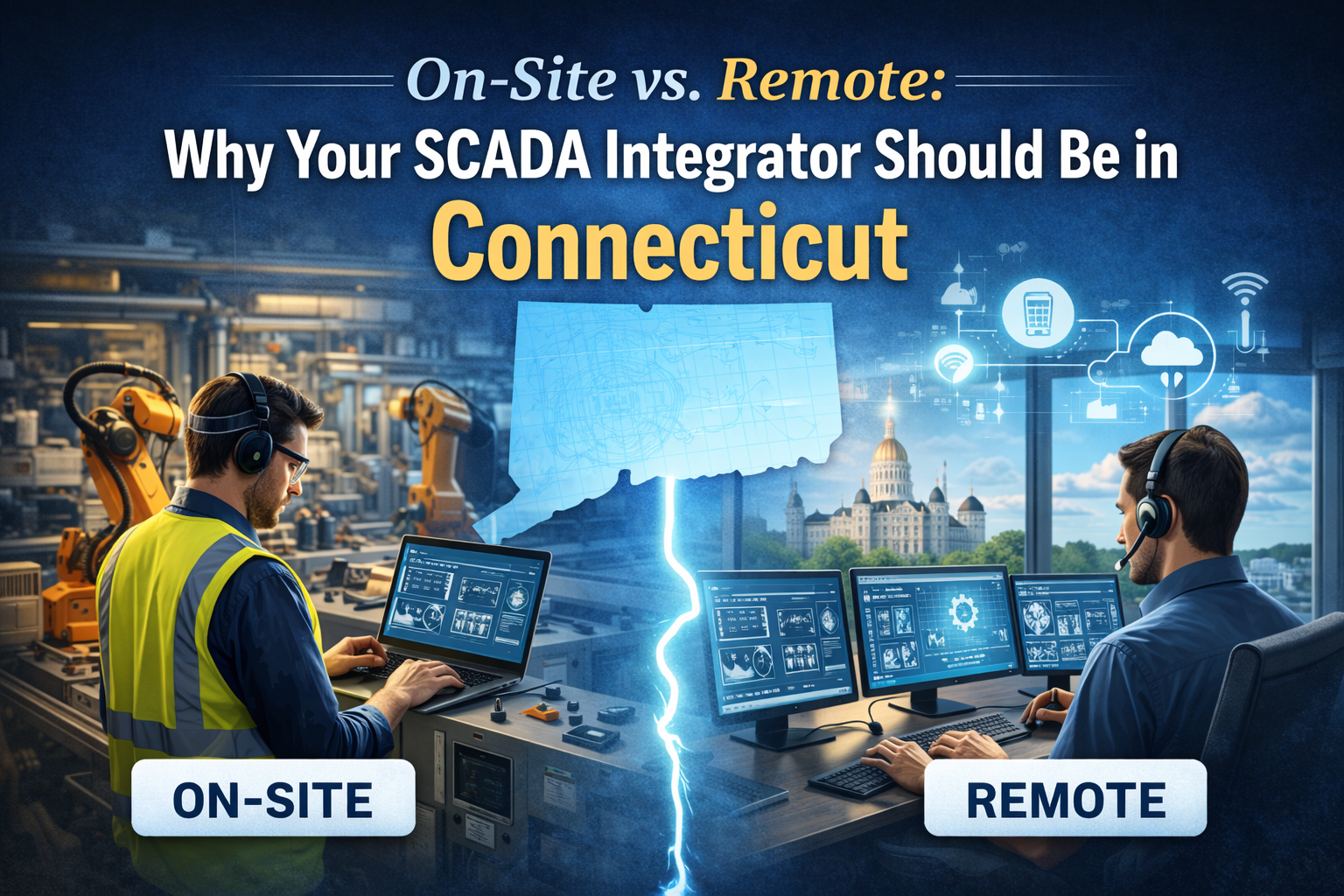
In a world where software can be coded from anywhere, many manufacturers consider hiring remote-only automation firms to save on overhead. However, when it comes to SCADA (Supervisory Control and Data Acquisition), distance is a hidden cost.
For a plant in the Hartford, Waterbury, or New Haven areas, the value of a local integrator isn’t just about a handshake—it’s about the physics of the manufacturing floor.
The Problem with “Remote-First” Integration
Remote firms are excellent at writing code, but they are blind to the physical realities of your plant. A remote integrator cannot see the electrical noise from a nearby welder that is dropping your PLC signals. They cannot hear the bearing whine that signals an impending motor failure.
1. Response Time: The $5,600 Per Minute Problem
Industry research (including Gartner and ABB) suggests that for mid-sized manufacturers, downtime costs an average of $5,600 per minute. * The Remote Reality: If your HMI goes dark at 2:00 PM on a Tuesday, a remote firm starts a “support ticket.” They might remote-in by 4:00 PM. If the issue is a physical gateway failure, they can’t help you until they ship a part or fly someone in.
- The Local Advantage: A Connecticut-based integrator like Pronto can often be on your floor within two hours. We are local to the I-91 and I-95 corridors, meaning “on-site support” is a reality, not a luxury.
2. Hands-On Commissioning and Testing
A SCADA system is only as good as the data it receives. “Commissioning” is the process of ensuring that every sensor on your floor matches the digital twin on your screen.
- Remote firms often rely on your maintenance team to verify wiring, which pulls your staff away from their actual jobs.
- Local integrators perform the walk-throughs themselves. We verify the “Point-to-Point” wiring, calibrate the sensors, and ensure that the system works in the real world—not just on a developer’s laptop.
3. Understanding the CT Utility and Regulatory Landscape
Connecticut has unique energy challenges and incentives. A local integrator is familiar with Eversource and UI (United Illuminating) rebate programs for energy-efficient automation. We understand CT DEEP regulations and how your SCADA system can help you stay compliant with local environmental reporting.
FAQ: Choosing a Local SCADA Integrator in Connecticut
Why should I choose a CT-based integrator over a cheaper national firm?
The primary reason is emergency response and physical commissioning. National firms cannot provide the “boots on the ground” support required when hardware fails or when complex on-site troubleshooting is needed.
Does a local integrator help with Connecticut state grants?
Yes. Local integrators like Pronto are familiar with the Manufacturing Innovation Fund (MIF) and CCAT requirements, making it easier to provide the documentation needed for state-funded projects.
What areas of Connecticut does Pronto System Solutions serve?
We provide on-site SCADA integration and support to manufacturers across the entire state, including the industrial hubs of Hartford, New Haven, Stamford, Waterbury, and Bridgeport.
Can a local integrator work with my existing remote IT team?
Absolutely. We often act as the “bridge” between a company’s corporate IT (which may be remote) and the physical “Operational Technology” (OT) on the plant floor that requires hands-on attention.
How does being local improve the training of my staff?
We provide in-person, shift-by-shift training. Instead of a video call, we stand with your operators at the machine, ensuring they know exactly how to use the new SCADA interface in their actual working environment.